

Benefits of Buying Freshly Roasted Coffee: A 2026 Guide
Table of Contents
- Why Freshly Roasted Coffee Tastes Better Than Store-Bought
- The Science Behind Freshness: Degassing, Oxidation, and Aromatic Compounds
- Coffee Roast Date vs Expiration Date: What You Need to Know
- How to Store Coffee Beans for Freshness at Home
- The Benefits of Grinding Coffee Beans Before Brewing
- Health Benefits and Antioxidants in Fresh Coffee
- How Freshness Impacts Different Brewing Methods
- Frequently Asked Questions
Last Updated: October 4, 2026
Why Freshly Roasted Coffee Tastes Better Than Store-Bought
The benefits of buying freshly roasted coffee start with a simple fact: coffee is an agricultural product, and like all agricultural products, it fades.
Most grocery store coffee was roasted months before it reached the shelf. Sealing and nitrogen-flushing slow the decline but cannot stop it: once roasted, coffee begins losing the volatile compounds responsible for aroma and flavor clarity from day one.
Freshness is not a marketing word but a measurable chemical state. Below: the science of degassing and oxidation, how to read a roast date, storage, and how freshness changes brewing performance.
The Science Behind Freshness: Degassing, Oxidation, and Aromatic Compounds
Roasted coffee is chemically active. Two processes run simultaneously after roasting: degassing and oxidation. Understanding both explains nearly every freshness question a coffee drinker has.
Degassing is the release of carbon dioxide trapped inside the bean during roasting. Oxidation is the reaction of coffee's oils and aromatic compounds with oxygen in the air, which flattens flavor over time. The Specialty Coffee Association's guidance on coffee freshness describes this balance as the central challenge in packaging and storage.
Freshly roasted coffee is not automatically at its best. It is at its most active, which is a different thing.
How Carbon Dioxide Release Affects Your Brew
Carbon dioxide interferes with water's ability to extract soluble material from ground coffee. Brew too soon and the CO2 pushes water away from the grounds, producing an uneven, sometimes sour or hollow cup.
The bloom you see when hot water hits fresh grounds is carbon dioxide escaping (Coffee Decoded: What is “freshly roasted” coffee?). A vigorous bloom is a decent freshness signal. A weak or absent bloom usually means the coffee has already degassed most of its CO2.
The Role of Essential Oils and Moisture Content
Coffee's aromatic compounds are carried largely in the oils inside the bean, and those oils are vulnerable to oxygen, heat, light, and moisture. Beans that absorb humidity degrade faster, which is why a sealed, opaque, airtight container beats a decorative glass jar every time.
Coffee Roast Date vs Expiration Date: What You Need to Know
The roast date tells you when the coffee was actually roasted. The expiration date tells you when the roaster believes the bag is no longer worth drinking. Only one is useful for judging freshness.
A common mistake is treating a distant expiration date as proof of quality.
| Label Element | What It Tells You | What It Does Not Tell You |
|---|---|---|
| Roast date | When the beans were roasted | How they were stored since |
| Expiration date | The roaster's outer limit | How fresh the coffee still is |
| "Best by" month | A rough shelf-life estimate | Whether a roast date exists |
| No date at all | Nothing verifiable | Anything about actual freshness |
If you take one habit from this section, make it this: buy from roasters who print a roast date, and treat the first two to four weeks after that date as your freshness window.
How to Store Coffee Beans for Freshness at Home
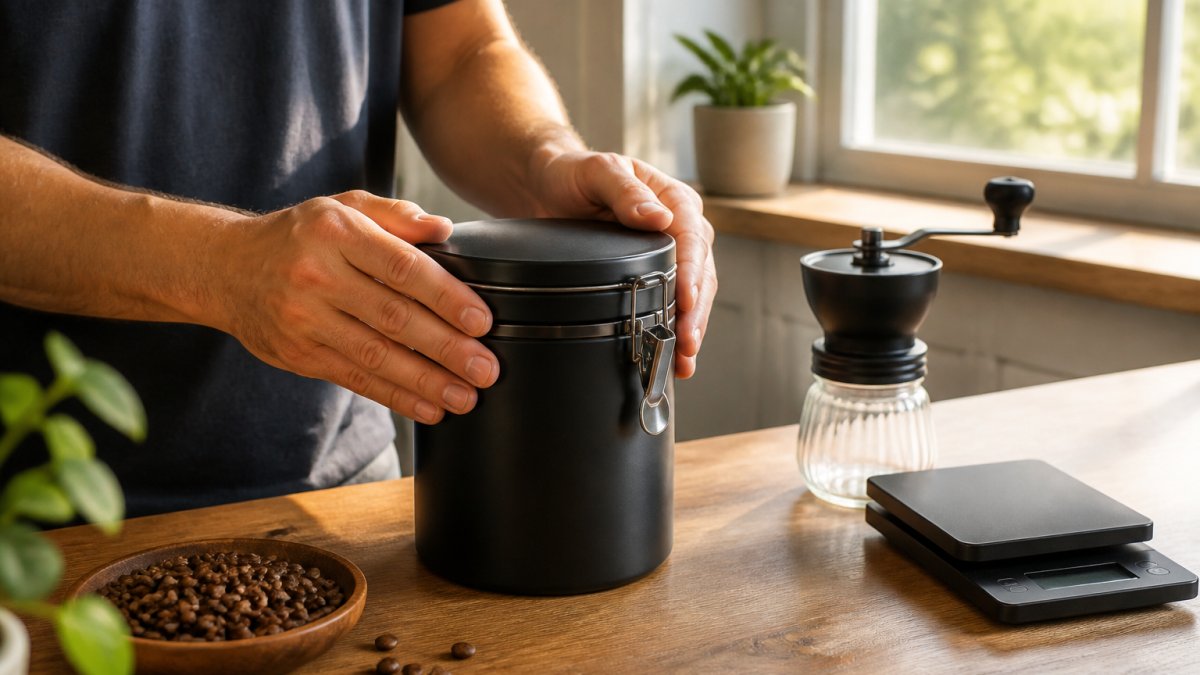
The best way to store coffee beans for freshness is in an airtight, opaque container kept in a cool, dark place, ideally used within two to four weeks of the roast date. The longer answer is more useful, because most storage advice repeats the same four enemies, oxygen, heat, light, and moisture, without explaining how each damages the bean.
What Each Enemy Actually Does
Oxygen drives oxidation, the reaction that turns aromatic oils into flatter, papery compounds. It is the primary long-term threat.
Moisture is the fastest-acting threat. Coffee beans are hygroscopic, absorbing water vapor that accelerates oxidation, dulls the grind, and can introduce off-flavors.
Heat accelerates every chemical reaction, including the ones you are trying to slow.
Light degrades oils and accelerates staling, which is why opaque containers beat clear glass jars. A clear jar on a sunny counter is one of the worst common setups.
The Container Trade-Offs
There is no perfect container, only trade-offs:
- Original bag with a one-way degassing valve, clipped shut: Good. The valve lets CO2 escape without letting oxygen in. Cheap and effective if you press out excess air.
- Airtight opaque canister: Good. Best for beans past their peak degassing window. Does not vent CO2, so do not seal very fresh beans in one immediately.
- Vacuum-sealed bags: Excellent for freezing and long-term storage. Poor for daily access, since every opening breaks the seal.
- Clear glass jar: Poor. Light exposure and no gas control.
- Grinder hopper: Worst for storage. Continuous air exposure. A hopper holds a day or two of beans at most before flavor clarity drops noticeably.
Freezing: When It Works and When It Fails
Freezing is a legitimate option, with caveats. Whole beans frozen in a vacuum-sealed bag and thawed once, without repeated temperature swings, hold up well for months. The mistake is repeatedly opening the bag and returning it to the freezer: every cycle introduces moisture through condensation, and that moisture does more damage than the cold prevents.
The correct method is portioning: divide the bag into single-week or single-dose portions, vacuum-seal or bag them tightly, freeze, and thaw only what you will use. Do not refreeze; once thawed, treat the beans as fresh.
A Practical Checklist
- Buy whole bean, not pre-ground
- Transfer to an airtight, opaque container, or keep the original bag sealed and clipped
- Store away from the stove, the window, and the top of the fridge
- Grind immediately before brewing, not in advance
- Buy in quantities you will finish within a few weeks
- If freezing, portion first and thaw only what you will use
Visual Signs Your Beans Are Losing Freshness
Fresh beans look slightly matte and dry and smell intensely aromatic when you open the bag. As they age, the surface can turn oily and glossy (especially darker roasts), the aroma weakens, color dulls, and the beans may feel lighter and more brittle.
None of these signs is definitive on its own, but together they form a useful checklist. If the bag has no roast date and the beans smell like cardboard, you have your answer.
The Benefits of Grinding Coffee Beans Before Brewing
Grinding immediately before brewing is the single highest-return habit in coffee preparation.
Grind consistency matters as much as timing. An uneven grind produces uneven extraction, some particles give up everything while others barely contribute, resulting in a cup that tastes simultaneously bitter and weak.
- Blade grinders chop unevenly and generate heat. Fine for spices, poor for coffee.
- Burr grinders crush beans to a consistent size. This is the difference that shows up in the cup.
- Match the grind to the method: coarse for French press, medium for drip, fine for espresso.
A practical rule: if you are not ready to buy a burr grinder, buy your coffee pre-ground from a roaster who grinds to order, and use it fast. Fresh ground coffee beats stale whole bean for most drinkers.
Health Benefits and Antioxidants in Fresh Coffee
Most guides repeat the same line: coffee has antioxidants, so fresh coffee must be healthier. That framing is imprecise.
Green coffee beans contain chlorogenic acids, polyphenols that act as antioxidants. Roasting transforms them: some degrade, some polymerize into melanoidins, and total antioxidant capacity shifts with roast level.
Where freshness enters is oxidation.
A few grounded points worth knowing:
- Caffeine is stable. It barely degrades with age or roast level. If caffeine is your only goal, freshness is irrelevant.
- Chlorogenic acids decline with roast and with time. Lighter roasts and fresher beans retain more.
- Melanoidins increase with roast. They contribute antioxidant activity and much of the body and bitterness in darker coffee.
- Diterpenes (cafestol, kahweol) are present in coffee oils and are more concentrated in unfiltered brews like French press and espresso. Paper filters trap most of them. This is a real, measurable difference between brewing methods, not a freshness issue.
For caffeine intake guidance, the FDA's guidance on coffee and caffeine is a sensible reference point rather than any antioxidant claim.
The underrated benefit is behavioral. Stale coffee tastes flat and hollow, so drinkers compensate with sugar, flavored syrup, and cream.
How Freshness Impacts Different Brewing Methods
Freshness does not affect every brewing method the same way, and matching your coffee's age to your method is a useful skill.
Pour-over and drip methods are the most sensitive to degassing. Very fresh coffee blooms dramatically and can brew unevenly if you do not give it a moment to settle. Espresso is also sensitive: too fresh and the shot runs unpredictable, gushing or channeling.
| Brewing Method | Ideal Rest After Roast | Why |
|---|---|---|
| Espresso | 7-14 days | CO2 stabilizes, extraction becomes predictable |
| Pour-over / drip | 4-14 days | Bloom settles, flavor clarity peaks |
| French press | 3-21 days | Long contact time tolerates more variation |
| Cold brew | 5-30 days | Extended steep masks minor staleness |
The practical takeaway: if your espresso tastes erratic, the beans may simply be too fresh. Give them a few more days. If your drip coffee tastes flat, they may be too old.
For anyone who wants to skip the guesswork, Crystal Coast Coffee Co. roasts to order, so the bag arrives within the freshness window rather than at the end of it. Our Whiskey Barrel Aged single origin Guatemalan is aged 30 days in a Bourbon barrel and then roasted to order, which makes the roast date on the bag genuinely meaningful. The Ethiopia Natural, a medium-light roast with milk chocolate, fruity, and caramel notes, and the Tanzania with its pear, floral, jasmine, and strawberry profile, both reward drinking within the first few weeks. For a smoother, cocoa-forward cup, the Brazil Santos is an easy everyday option.


Freshness is the one variable in coffee you control completely, and the one most drinkers ignore. Crystal Coast Coffee Co. roasts to order so your coffee arrives inside its peak window, ships it to your door, and offers a range of single origins and blends.
Frequently Asked Questions
How long does freshly roasted coffee stay fresh after roasting?
Freshly roasted coffee reaches peak flavor about 3-7 days after roasting and stays at its best for roughly 2-4 weeks when stored properly. After that, oxidation and degassing cause volatile compounds to fade, leading to flatter taste and reduced aroma. Buying from a roaster that ships within days of roasting, like Crystal Coast Coffee Co., gives you a longer freshness window than grocery store bags that may sit on shelves for months.
What are the benefits of grinding coffee beans before brewing?
Grinding right before brewing exposes the bean's interior to oxygen for only minutes instead of days, preserving aromatic compounds and essential oils that create flavor clarity and natural sweetness. Pre-ground coffee loses volatile compounds quickly and often tastes flat or bitter. For best results, grind to match your brewing method: coarse for French press, medium for drip, fine for espresso.
How does roast date affect the flavor profile of coffee?
Roast date tells you when the beans were roasted, not just when they expire. Coffee at its peak, typically 3-14 days post-roast, delivers balanced acidity, distinct tasting notes, and a fuller body. As beans age past 4 weeks, staling process reduces flavor clarity and introduces bitterness or papery notes. Always check the roast date, not the expiration date, when judging freshness.
What are the signs that coffee beans are no longer fresh?
Fresh beans have a visible sheen from essential oils, a strong aroma when you open the bag, and a satisfying crack when ground. Stale beans look dry and matte, smell faint or like cardboard, and produce a flat or bitter cup with little aftertaste. If your beans don't bloom (bubble up) when hot water hits them, they've likely lost most of their carbon dioxide and freshness.