

Light vs Dark Roast: How to Choose Your Perfect Coffee
Table of Contents
- Light vs Dark Roast: What Actually Changes During Roasting
- Coffee Roast Flavor Profiles: From Bright and Fruity to Bold and Smoky
- Caffeine Content in Light vs Dark Roast: The Myths and the Facts
- Acidity, Body, and Mouthfeel: What to Expect in Your Cup
- Best Brewing Methods for Dark Roast Beans (and Which Suit Light Roasts)
- A Quick Comparison: Light vs Dark Roast at a Glance
- How to Choose: Matching Roast Level to Your Taste and Routine
- Conclusion
- Frequently Asked Questions
Last Updated: September 6, 2026
The choice between light and dark roasts is one of the most personal decisions a coffee drinker makes, yet it is often driven by habit rather than understanding. It ultimately comes down to flavor preference, brewing style, and how you take your coffee, not outdated assumptions about strength or caffeine. At Crystal Coast Coffee Co., we roast every batch to order, ensuring maximum flavor, aroma, and character in every cup. Below, we break down what changes during roasting, what those changes mean for your cup, and how to pick the roast that fits your routine.
Light vs Dark Roast: What Actually Changes During Roasting
Roasting is a heat-driven process that transforms dense, green coffee seeds into the aromatic, brittle beans you grind each morning. During the roasting process, the bean undergoes the Maillard reaction and caramelization, which develop color, aroma, and flavor compounds. Light roasts are stopped shortly after the first crack, preserving more of the bean's origin character, while dark roasts are pushed further, sometimes to the second crack or beyond, until the bean's internal sugars caramelize deeply and oils migrate to the surface.
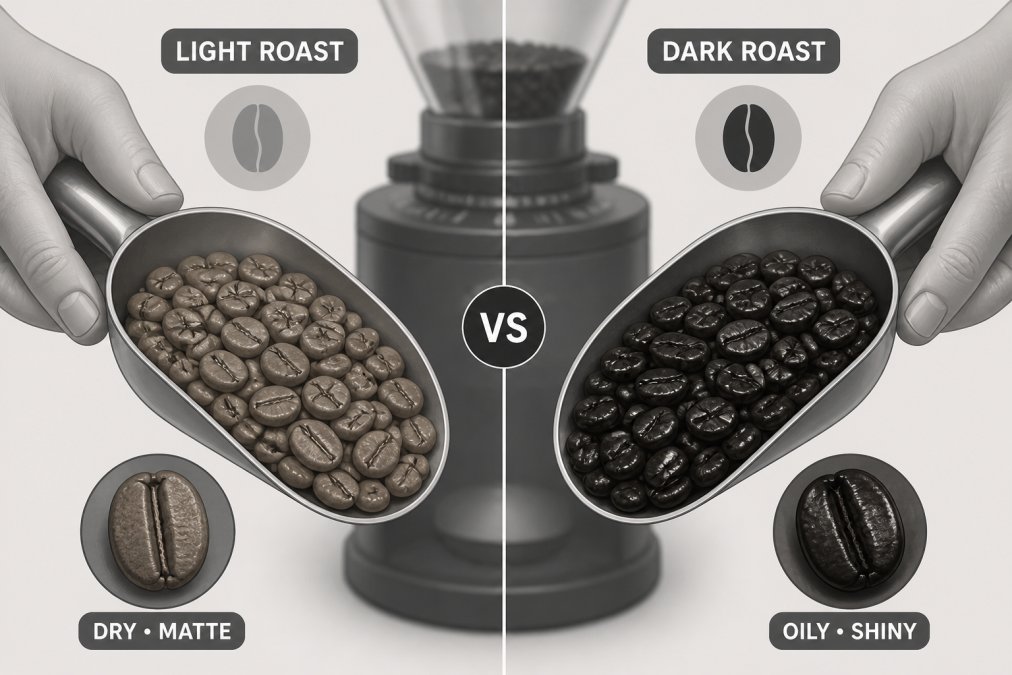
The most visible difference is surface oil content. Dark roast beans develop a shiny, oily sheen because the extended roast temperature breaks down the bean's cellular structure, pushing oils outward. Light roast beans remain dry and matte. Bean density also drops as roasting progresses, which changes how water flows through the grounds during extraction.
Coffee Roast Flavor Profiles: From Bright and Fruity to Bold and Smoky
Coffee roast flavor profiles exist on a spectrum, and understanding that spectrum is the fastest way to narrow your choice. Light roasts are bright, fruity, and nuanced, with pronounced acidity and delicate floral or citrus notes that come directly from the origin bean. Dark roasts are bold, strong, and smoky, with bittersweet chocolate, caramel, and toasted nut flavors that come from the roasting process itself.
Origin-forward characteristics like fruity or wine-like notes survive best in light roasts. If you enjoy Ethiopian beans with blueberry notes or a Kenyan roast with bright grapefruit acidity, a light roast preserves those qualities. Dark roasts, by contrast, prioritize the roast character over the bean's origin, delivering a consistent, heavy-bodied cup where the processing method matters less than the roast temperature.
Caffeine Content in Light vs Dark Roast: The Myths and the Facts
The most persistent myth about caffeine content in light vs dark roast is that dark roast has more caffeine because it tastes stronger. The opposite is actually true by volume. Since light roast beans are denser and retain more mass after roasting, a scoop of light roast grounds contains marginally more caffeine than the same scoop of dark roast beans (peer-reviewed research).
That said, the difference is negligible in practice. The perception of strength in a dark roast comes from its bold, bitter flavor and heavier body, not from a stimulant boost. If you are choosing a roast for caffeine, you will notice far more difference from your brewing method, your coffee-to-water ratio, and your serving size than from the roast level itself.
Acidity, Body, and Mouthfeel: What to Expect in Your Cup
Acidity and body are the two sensory qualities that most clearly separate light and dark roasts. Light roasts are known for their bright, tangy acidity, which is often described as crisp or wine-like, and their lighter body, which leaves a clean, tea-like mouthfeel. Dark roasts are low in perceived acidity and high in body, producing a syrupy, full mouthfeel with a lingering finish.
If you find that coffee upsets your stomach, the higher acidity in light roasts can be a trigger. Dark roasts are generally gentler on digestion because the roasting process breaks down some of the chlorogenic acids (PubMed). However, the tradeoff is that dark roasts can taste bitter, especially if you over-extract them or drink them black.
Best Brewing Methods for Dark Roast Beans (and Which Suit Light Roasts)
Most guides stop at "dark roasts suit espresso, light roasts suit pour-over." That misses the real decision: how each brewer extracts solubles differently, and which roast level forgives or punishes your technique.
French Press
Best for: Dark roasts. The metal mesh filter lets natural oils and fine particles through, which builds body and rounds out bitter edges. A dark roast's low acidity and high solubility tolerate the full-immersion steep without turning harsh. Use a coarse grind and a 4-minute steep, then press slowly. Light roasts work here too, but you will lose the crisp, tea-like clarity that makes their floral notes shine.
Pour-Over (V60, Chemex)
Best for: Light roasts. This is where light roasts show their origin character. The paper filter strips oils and sediment, and the controlled flow rate lets you extract the delicate, fruity acids before bitterness kicks in. The catch: light roasts are dense and less soluble, so you need a finer grind and hotter water (around 205°F) than intuition suggests. Dark roasts in a pour-over often taste hollow or ashy because the filter removes the body that balances their roast character.
AeroPress
Best for: Both, with a tweak. The AeroPress is the most forgiving brewer because pressure and immersion extract evenly. For light roasts, use a 2-minute steep with a medium-fine grind to pull out sweetness. For dark roasts, shorten the steep to 90 seconds and use slightly cooler water (around 195°F) to avoid over-extracting bitter compounds.
Moka Pot
Best for: Dark roasts. The moka pot operates at around 1.5 bars of pressure and produces a concentrated, espresso-like brew. Dark roasts' low acidity and high solubility match this aggressive extraction. Light roasts in a moka pot often come out sour and sharp because the brewer cannot reach the temperatures needed to break down their dense cellular structure.
Drip Coffee Maker
Best for: Medium roasts, acceptable for dark. Automatic drip brewers typically hit 195-200°F and spray water unevenly. Dark roasts tolerate this inconsistency, but you risk a bitter, over-extracted cup if the brewer runs hot. Light roasts usually end up under-extracted and sour. If you only own a drip machine, a medium roast is the safest bridge.
Espresso Machine
Best for: Dark roasts traditionally, light roasts with skill. Traditional espresso relies on dark roasts because their solubility allows a 25-30 second extraction at 9 bars of pressure. Modern specialty cafes, however, pull light roasts as espresso by extending the ratio (1:2.5 or longer) and raising the brew temperature to 200-203°F. If you are dialing in at home, start with dark, then experiment with light only after you have your grinder and temperature stable.
The Extraction Principle That Ties It Together
Roast level changes solubility. Dark roasts are more soluble because roasting breaks down cell walls and caramelizes sugars, so they extract quickly and tolerate heat. Light roasts are less soluble, so they need more contact time, finer grinds, or higher temperatures to reach their sweet spot. Match your brewer's extraction style to the roast's solubility for a better cup than any single "best method" rule.
A Quick Comparison: Light vs Dark Roast at a Glance
Beyond flavor, roast level changes how you store, brew, and digest your coffee. This table condenses the full picture.
| Attribute | Light Roast | Dark Roast |
|---|---|---|
| Bean surface | Dry, matte, dense | Oily sheen, brittle, less dense |
| Flavor source | Origin character (fruit, floral, citrus) | Roast character (chocolate, caramel, smoke) |
| Acidity | High, bright, tangy | Low, muted |
| Body | Light, tea-like | Full, syrupy |
| Solubility | Low, needs finer grind, hotter water | High, extracts quickly, tolerates heat |
| Best brewers | Pour-over, AeroPress | French press, moka pot, espresso |
| Caffeine (by scoop) | Marginally higher (denser beans) | Marginally lower (less mass per scoop) |
| Chlorogenic acid content | Higher, may trigger stomach sensitivity | Lower, roasting breaks down acids |
| Antioxidant activity | Higher overall | Lower, but different compounds form |
| Degassing peak | Slower, peaks 5-7 days post-roast | Faster, peaks 2-4 days post-roast |
| Staling pattern | Gradual loss of brightness | Rapid oxidation of surface oils, stale flavor within 2 weeks |
| Best storage window | 3-6 weeks from roast date | 1-2 weeks from roast date |
The Freshness Difference Most Buyers Miss
Dark roasts degas faster because roasting opens the bean's cellular structure, releasing CO₂ rapidly in the first few days. That is why a dark roast tastes best 2-4 days after roasting, then declines quickly as surface oils oxidize. Light roasts degas more slowly, holding their peak flavor for up to a week and staying drinkable for several weeks longer.
If you buy in bulk or drink coffee slowly, light roasts are the more forgiving choice. If you want the darkest, richest cup possible, buy dark roasts in smaller quantities and finish them within two weeks of the roast date.
The Stomach Sensitivity Angle
Light roasts contain higher levels of chlorogenic acid, which can stimulate stomach acid production and cause discomfort for sensitive drinkers. Dark roasts break down more of these acids during the extended roast, which is why many people find them gentler on digestion. The tradeoff is that dark roasts can trigger heartburn through higher levels of N-alkanoly-5-hydroxytryptamides, compounds formed during roasting that relax the lower esophageal sphincter (PubMed). If coffee upsets your stomach, neither extreme is guaranteed safe, a medium roast often sits best.
The Middle Ground: Medium and Omni-Roasts
The binary choice between light and dark ignores the nuance most roasters actually produce. A medium roast (often labeled "City+" or "Full City") balances origin brightness with roast sweetness, making it the most versatile daily option. An omni-roast is designed to work across brewing methods without favoring one extreme. If you are torn, start with a medium roast from a roaster that publishes its roast profile, then move toward light or dark based on what you miss in the cup.
How to Choose: Matching Roast Level to Your Taste and Routine
Start with how you take your coffee. If you drink it black, a light roast lets you taste the origin and processing method clearly. If you add cream or milk, a dark roast holds its own better, with the bitter, smoky flavors cutting through the dairy instead of disappearing.
Consider your brewing setup next. Espresso drinkers have traditionally reached for dark roasts because their low acidity and high solubility suit the quick, high-pressure extraction. However, modern specialty cafes are pulling origin-forward light roasts as espresso with impressive results, so do not feel locked into tradition if you enjoy bright, fruity shots.
Freshness also matters. Dark roasts peak a few days after roasting and fade faster because the surface oils oxidize. Light roasts hold their character longer, which makes them forgiving if you buy in bulk. At Crystal Coast Coffee Co., we roast to order and ship quickly, so your beans arrive at their peak regardless of roast level. Consider our Italian Roast and French Roast for two distinct takes on the dark end of the spectrum.


Conclusion
The best roast is the one that makes you look forward to your next cup. Light roasts reward drinkers who chase nuance and origin character, while dark roasts deliver the bold, comforting consistency that pairs with milk, dessert, or a quiet morning. Start with your brewing method, think about whether you add anything to your cup, and do not be afraid to try both.
At Crystal Coast Coffee Co., we roast every batch to order so you get the full flavor potential of whichever roast you choose, from our bright Breakfast Blend to our darkest Italian Roast. Explore our full coffee collection and find the roast that fits your routine. Get started with Crystal Coast Coffee Co. and taste the difference that roasting to order makes in every cup.

Frequently Asked Questions
Does dark roast coffee have more caffeine than light roast?
No, this is a common myth. By weight, the beans are nearly identical in caffeine content. Since dark roasts are roasted longer, they lose more water weight, so a scoop of dark roast beans may contain slightly more caffeine than a scoop of light roast. However, most people brew by volume, not weight, making the difference negligible in a standard cup.
Is light roast coffee actually healthier than dark roast?
Light roasts retain slightly more chlorogenic acid, a compound with antioxidant properties that degrades during longer roasting. Dark roasts produce higher levels of compounds formed during the Maillard reaction, which also have antioxidant activity. Both roasts offer health benefits, so the difference is minor compared to the overall quality and freshness of the bean.
Is dark roast coffee less acidic than light roast?
Yes. The roasting process breaks down chlorogenic acids, which are the primary source of acidity in coffee. As beans roast longer, they become less acidic. If you have a sensitive stomach, a dark roast like our <a href="https://crystalcoastcoffeeco.shop/products/french-roast">French Roast</a> may offer a smoother, lower-acid cup.
What are the drawbacks of light roast coffee?
Light roasts can taste overly sour or grassy if they are underdeveloped or brewed improperly. They are also denser than dark roasts, making them harder to grind and extract. Achieving a balanced, sweet cup from a light roast often requires a precise grinder and a scale, which can be a hurdle for casual coffee drinkers.
Which roast profile is best for pour-over brewing?
Light roasts are traditionally favored for pour-over methods like the V60 or Chemex. Their higher acidity and complex, fruity notes shine with this brewing method, which highlights clarity and origin characteristics. That said, a medium-dark roast can also produce an excellent, balanced pour-over if you prefer a bolder, less bright cup.