

How to Choose Coffee Roast Profiles: 2026 Guide
Table of Contents
- Roast Profiles vs Roast Levels: What Actually Differs
- How Bean Origin and Density Shape Your Roast Profile
- Processing Methods and Their Impact on Roast Development
- Light vs Dark Roast Acidity: Finding Your Balance
- Dark Roast Coffee Beans: What You Gain and What You Lose
- Best Coffee Roast for Espresso and Other Brewing Methods
- Troubleshooting Roast Profiles and What to Ignore
- Conclusion
- Frequently Asked Questions
Last Updated: September 12, 2026
Roast Profiles vs Roast Levels: What Actually Differs
Coffee roast profiles are the full record of how heat, airflow, and time are applied to a batch of green coffee from charge to drop, while a roast level is simply where that batch landed on the color scale. This guide from Crystal Coast Coffee Co. breaks down how to choose coffee roast profiles that match your beans, your brewing method, and your taste. The distinction matters because two roasters can finish at the same medium-brown color and still produce completely different cups.
Roast profile is the recipe: charge temperature, gas adjustments, airflow changes, and the timing of first crack. Roast level is the outcome: light, medium, or dark, judged by bean color and surface oil.
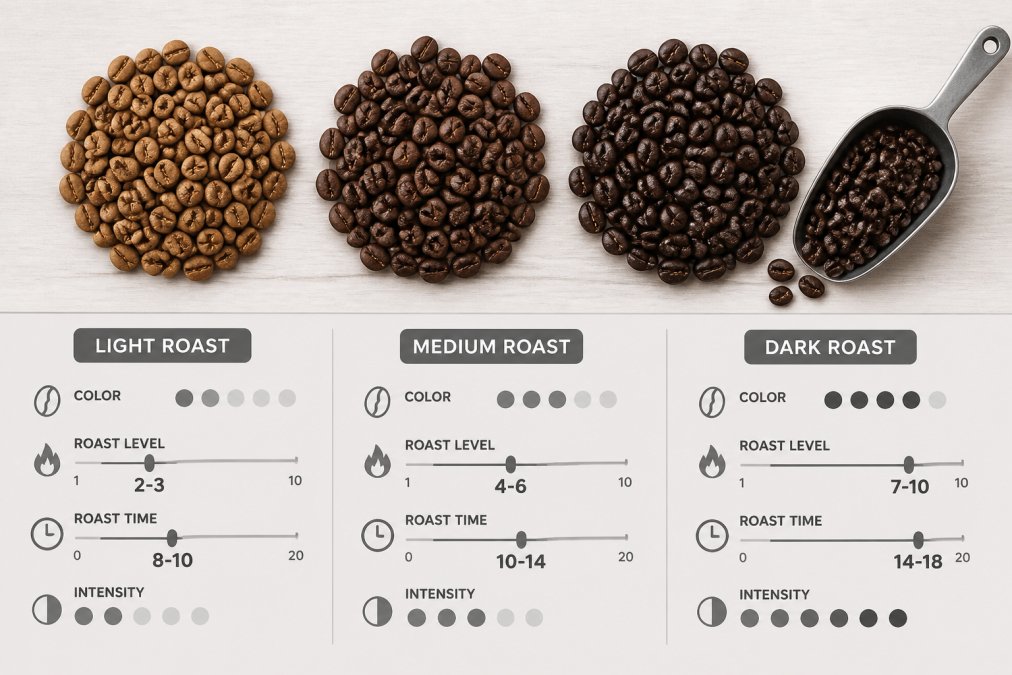
Most home roasters obsess over the destination and ignore the route. That is backwards. A fast, hot profile and a slow, gentle profile can both hit "medium," but the first tends to taste baked and flat while the second develops sweetness and clarity.
How Bean Origin and Density Shape Your Roast Profile
Dense, high-grown beans need more thermal energy to roast evenly than soft, low-grown beans. Bean density is largely a function of altitude: slower maturation at high elevation produces a tighter cell structure and lower internal porosity, so heat has to travel farther through solid mass before it reaches the center of the bean. A coffee grown at 1,700 to 1,900 meters behaves very differently in the roaster than a bean grown at 1,200 meters, even when both are the same varietal and processed the same way.
Reading Density Before You Ever Charge the Drum
You do not need a lab to estimate density. Three cheap signals get you close:
- Weight per volume. Fill a one-liter measuring cup with green beans and weigh them. A dense high-grown lot typically lands around 700-750 g/L; a soft low-grown lot often sits closer to 600-650 g/L. Same volume, very different thermal mass.
- Screen size vs. weight. Large beans that feel light for their size are usually porous and low-density. Small beans that feel heavy are usually dense.
- Moisture content. Green coffee is typically traded at 10-12% moisture by weight (peer-reviewed research). Beans at the high end of that range (11.5-12%) need a longer drying phase before first crack; beans at 9-10% can race through drying and scorch if you apply the same heat.
What Density Actually Changes in the Roast
- High density (high altitude): absorbs heat slowly, tolerates longer roast times, rewards a gentle and steadily declining rate of rise. These beans can take a higher charge temperature because their thermal mass buffers the initial energy transfer.
- Low density (low altitude): heats fast, risks scorching and tipping, and needs a lower charge temperature, often 20-30°F lower than a dense lot on the same roaster.
- Varietal matters too: Bourbon and Typica tend to be denser than Catimor hybrids, and Pacamara is famously large but relatively porous. Two beans from the same farm at the same altitude can still roast differently if the cultivars differ.
The Origin-to-Profile Cheat Sheet
| Origin Profile | Typical Density | Charge Temp Adjustment | Rate of Rise Style |
|---|---|---|---|
| East Africa, 1,800 m+ | High | +10 to +15°F over baseline | Slow, steady decline |
| Central America, 1,400-1,700 m | Medium-high | Baseline | Moderate decline |
| Brazil / low-grown | Low-medium | −10 to −15°F under baseline | Faster early, taper hard |
| Island / soft-bean lots | Low | −20 to −30°F under baseline | Gentle throughout |
If you roast a dense Ethiopian the same way you roast a soft Brazilian, one of them will taste wrong. Usually both. The dense bean will taste underdeveloped and grassy; the soft bean will taste baked or ashy because you pushed heat it could not absorb.
The Gap Most Guides Skip: Density Is Not Constant
Every published profile number you read online assumes a fixed density and moisture content. In reality, the same farm can ship you a 720 g/L lot in one harvest and a 680 g/L lot the next, depending on rainfall and cherry ripeness. Treat density and moisture as variables you re-measure each crop, not constants you memorize once. That single habit separates roasters who can repeat a great batch from roasters who chase it.
Processing Methods and Their Impact on Roast Development
Processing method determines how much sugar and moisture remain in the bean before it ever sees heat. That directly changes how the Maillard reaction and caramelization unfold during roasting.
Washed, Natural, and Honey: What Each Means for Roasting
Washed coffees are depulped and fermented before drying, leaving a clean, high-acidity bean. They show origin characteristics clearly and roast predictably across many profiles.
Natural coffees dry inside the whole fruit, absorbing sugars that boost sweetness and body. They brown faster and can scorch if you push heat early. Our Ethiopia Natural is a full natural, dried on raised beds, and it rewards a med-light profile that protects those fruity, caramel notes.

Honey coffees sit between the two, with some mucilage left on during drying. They take heat well but can turn muddy if roast development runs long.
Light vs Dark Roast Acidity: Finding Your Balance
Light roasts retain more of the bean's natural acids, citric, malic, and chlorogenic, because those compounds degrade with heat and time. Dark roasts destroy much of that acidity in the roaster, trading it for bittersweet, smoky notes created by extended pyrolysis. Light versus dark roast acidity comes down to how far past first crack you go, and how fast.
The Mechanism, Not the Slogan
Three reactions drive the shift you taste:
- Maillard reaction (roughly 300-400°F bean temp): amino acids and reducing sugars combine to build the brown color and much of the sweetness and body. Push this phase too fast and you get baked, bread-like flavors instead of caramel.
- Caramelization (roughly 340-400°F): sugars break down into hundreds of aromatic compounds. This is where a medium roast earns its sweetness.
- Pyrolysis (past first crack, roughly 400°F+): heat begins breaking down the bean's own structure. Some roast character is desirable; too much and you taste ash and carbon rather than coffee.
A common pattern among home roasters is to stretch the Maillard phase for sweetness, then rush development after first crack. That produces a cup that smells sweet but tastes hollow. The fix is usually to shorten the total roast and lengthen the post-first-crack window slightly, not to push either phase harder.
The Caffeine Myth, Settled
One of the most repeated claims in coffee is that dark roasts have more caffeine because they taste stronger. The opposite is closer to true by weight. Caffeine is thermally stable at roast temperatures, so it is not destroyed, but it is diluted. As beans lose 15-20% of their mass to water and organic compounds during roasting, the caffeine that remains is concentrated in a smaller bean (peer-reviewed research). Measured by weight of ground coffee, a light roast typically carries slightly more caffeine than a dark roast of the same green lot. Measured by scoop, the difference flips, because dark beans are less dense and pack looser. If caffeine is your concern, weigh your dose, do not trust the color of the bean.
FDA guidance on caffeine and safe consumption levels
Finding Your Balance Point
The balance point is sweetness. You want enough development to caramelize sugars without burning off the compounds that make the cup interesting. Aim for a total roast time that lets acidity, sweetness, and bitterness sit in proportion. Two practical checkpoints:
- First crack timing: if first crack arrives before 7 minutes on a drum roaster, you are likely rushing the Maillard phase and will taste baked notes. If it arrives after 11 minutes, you risk a flat, papery cup.
- Development time ratio: the window from first crack to drop is typically 20-25% of total roast time for a balanced medium. Below 15% tends toward grassy and sharp; above 30% tends toward ashy and dull.
If the cup tastes sharp and grassy, you dropped too early. If it tastes ashy, you went too far. If it tastes like cardboard, you went too slow, that is a baked roast, not an underdeveloped one, and the fix is a shorter total time, not a longer one.
Dark Roast Coffee Beans: What You Gain and What You Lose
Dark roast coffee beans deliver body, low acidity, and a flavor profile that survives milk and sugar. That is the trade. You gain richness and consistency; you lose origin characteristics, flavor clarity, and much of the brightness that makes single-origin coffee distinctive.
| Roast Level | Acidity | Body | Best For |
|---|---|---|---|
| Light | High | Light | Pour-over, drip |
| Medium | Balanced | Medium | Drip, AeroPress |
| Med-dark | Low-medium | Full | Espresso, moka |
| Dark | Low | Heavy | Espresso, cold brew |
Our French Roast is a good example of the style done well: a deep dark roast of high-scoring African coffees, shiny with oil, bittersweet with low acidity. Our Italian Roast goes darker still, a slow-roasted Arabica and Robusta blend built for people who want the roast to lead.

Best Coffee Roast for Espresso and Other Brewing Methods
The best coffee roast for espresso is a medium-dark to dark roast, because espresso's short, high-pressure extraction struggles to pull flavor from lightly developed beans. That does not mean dark is universally better. It means the roast has to match the extraction method.
- Espresso: medium-dark to dark; our 6 Bean Blend is built for this
- Pour-over: light to medium; protects acidity and flavor clarity
- Drip: medium; forgiving and consistent
- Cold brew: dark; the long steep pulls sweetness from developed sugars
- French press: medium to medium-dark; body and oils come through
Match the roast to the method, not the other way around.

Troubleshooting Roast Profiles and What to Ignore
Most failed roasts trace back to one of four problems, and each has a specific fix.
| Problem | Likely Cause | Fix |
|---|---|---|
| Baked, flat flavor | Roast stretched too long | Shorten total roast time |
| Scorched, ashy taste | Charge temperature too high | Lower charge temp by 10-15°F |
| Uneven color | Insufficient airflow or drum speed | Increase airflow, adjust drum speed |
| Stalled rate of rise | Too much heat pulled mid-roast | Smooth your gas adjustments |
What should you ignore? Cupping scores you did not measure yourself, other people's exact profile numbers, and any advice that treats bean density and moisture content as constants. They are not.
Conclusion
Getting roast profiles right is a process of matching heat, time, and airflow to the specific bean in front of you, and that takes practice. Crystal Coast Coffee Co. does that work for you, sourcing beans from trusted farms and roasting to order so every bag arrives at peak flavor. Our Ethiopia Natural, Bali Blue, and 6 Bean Blend each carry a profile chosen to suit the bean and the brewing method. Explore the collection and taste what a properly matched roast profile delivers in the cup.
Frequently Asked Questions
What are the different roast profiles for coffee?
Roast profiles describe the full journey a batch of beans takes through the roaster, including charge temperature, rate of rise, first crack timing, and drop temperature. Roast levels are just the endpoint: light, medium, or dark. Two coffees can both be medium roast but taste completely different because one was roasted fast with high airflow and the other slow with low airflow. Profile is the process; level is the result.
Does a darker roast always mean more caffeine?
No. Caffeine content stays fairly stable during roasting, so dark roast coffee beans do not automatically deliver more caffeine than lighter roasts. What changes is the bean's mass: darker roasts lose more moisture and weight, so if you measure by scoop rather than by weight, a dark roast can actually give you slightly less caffeine per cup. For a reliable comparison, weigh your coffee on a scale instead of using a scoop.
How does roast profile affect the flavor of coffee?
Profile controls how much of the bean's origin character survives the roast. A gentle profile that ends shortly after first crack preserves acidity, floral notes, and fruit-forward flavors. A longer, hotter profile pushes Maillard reactions and caramelization further, building body and bittersweet chocolate notes while muting origin characteristics. The same green bean can taste like blueberry or baking chocolate depending on how you roast it.
What is the best coffee roast for espresso?
Medium to medium-dark roasts work best for most espresso setups because they balance sweetness with enough soluble material to stand up to 9 bars of pressure. A medium-dark single origin like Bali Blue pulls rich dark chocolate and molasses shots without turning bitter. Very light roasts can taste sour and thin as espresso, while very dark roasts risk ash and char. Start medium-dark, then adjust grind before changing roast.
How do I choose a coffee roast based on my brewing method?
Match the roast to how long water contacts the grounds. Pour-over and drip reward light to medium roasts because they highlight acidity and flavor clarity. French press and cold brew suit medium to dark roasts that hold up to longer immersion. Espresso and moka pot favor medium-dark to dark roasts with enough body and sweetness to survive pressure. If a brew tastes sour, go darker; if it tastes bitter or ashy, go lighter.
What is the difference between roast level and roast profile?
Roast level is the final color and development stage of the bean, usually described as light, medium, medium-dark, or dark. Roast profile is the complete recipe: charge temperature, batch size, airflow, drum speed, rate of rise, first crack timing, and drop temperature. Two roasters can hit the same roast level using very different profiles, which is why a medium roast from one roaster can taste nothing like a medium roast from another.