

Why Premium Coffee Costs More: The Real Reasons
Table of Contents
- The Real Economics Behind Premium Coffee Prices
-
7 Factors That Drive Up the Cost of Premium Coffee
- 1. Green Coffee Prices and the C-Price Market
- 2. Harvest Cycles and Climate Impact on Crop Yield
- 3. Fertilizer Prices, Fuel Surcharges, and Shipping Rates
- 4. Labor Costs and Wage Increases at Origin
- 5. Roasting Costs and the Difference Small Batch Roasting Makes
- 6. Origin Premiums, Fair Trade, and Direct Trade Relationships
- 7. Consumer Demand and Price Elasticity
- Specialty Coffee vs Commodity Coffee: What the Price Gap Actually Reflects
- The Benefits of Small Batch Roasted Coffee (and Why They Cost More)
- How to Store Fresh Roasted Coffee So You Get Every Penny's Worth
- Climate Adaptation, Futures Markets, and What's Next for Coffee Prices
- Conclusion
- Frequently Asked Questions
Last Updated: September 10, 2026
The Real Economics Behind Premium Coffee Prices
Why does premium coffee cost more? Almost every input between the farm and your cup has gotten more expensive, and specialty roasters absorb those costs without the scale mass-market brands use to hide them. This guide from Crystal Coast Coffee Co. breaks down the seven real cost drivers behind premium coffee, and why a $22 bag of roasted-to-order beans differs from a $9 grocery store tub.
The first thing to understand is that coffee trades as a global commodity. The C-price is the benchmark futures price for arabica coffee on the Intercontinental Exchange, and it sets the floor for what farmers can expect to earn. According to Intercontinental Exchange coffee futures overview, arabica futures move daily based on weather, currency, and speculation, and those swings ripple all the way to retail shelves.
For specialty roasters, the C-price is only the starting point. Beans that score well on quality, come from a single farm, or are grown at high altitude trade at a premium above it, often double or more.
7 Factors That Drive Up the Cost of Premium Coffee
Seven structural costs separate premium coffee from commodity coffee. Each one compounds the others, which is why the final price gap is wider than any single factor suggests.
| Factor | What It Covers | Why It Hits Premium Harder |
|---|---|---|
| C-price market | Global arabica benchmark | Specialty beans trade above it, not at it |
| Harvest and climate | Crop yield, volatility | Small farms absorb losses first |
| Fertilizer, fuel, shipping | Input and freight costs | Low volume means no bulk discounts |
| Labor at origin | Picking and processing wages | Quality picking is hand-picked, not mechanical |
| Roasting | Batch size and skill | Small batches cost more per pound |
| Origin premiums | Fair trade, direct trade | Certification and relationship costs |
| Consumer demand | Price elasticity | Buyers pay for freshness and traceability |
1. Green Coffee Prices and the C-Price Market
Green coffee is unroasted coffee, priced by the commodity market before a roaster touches it. The C-price fluctuates on Brazilian harvest forecasts, currency moves, and speculation. When it spikes, every roaster pays more, but specialty roasters pay more on top because they buy above the benchmark for quality.
2. Harvest Cycles and Climate Impact on Crop Yield
Coffee grows in a narrow band of tropical highlands and is harvested once a year per origin, so a bad harvest in one region tightens global supply. Drought, frost, and irregular rainfall have cut yields in recent seasons, and farms are investing in shade trees, irrigation, and replanting, adaptation costs priced into green coffee.
3. Fertilizer Prices, Fuel Surcharges, and Shipping Rates
Fertilizer prices, fuel surcharges, and shipping rates form the logistics layer of coffee pricing. Fertilizer tracks energy markets, and beans travel by truck, ocean, and rail to a roastery with surcharges at every leg, and small roasters ship smaller volumes with less negotiating power.
4. Labor Costs and Wage Increases at Origin
Specialty coffee is picked by hand, cherry by cherry, because machines can't tell a ripe bean from an unripe one, so labor costs directly shape quality. As wages rise at origin and more farms move toward fair compensation, the price of well-picked coffee rises with it.
5. Roasting Costs and the Difference Small Batch Roasting Makes
Roasting costs per pound fall as batch size grows. A large commercial roaster spreads fuel, labor, and equipment costs across enormous volume; a small-batch roaster running 10 to 30 pounds at a time spreads the same costs across a fraction of that output, adjusting every batch by hand.
6. Origin Premiums, Fair Trade, and Direct Trade Relationships
Origin premiums are the extra a roaster pays above commodity price for quality, traceability, or certification. Fair trade and direct trade relationships add cost but also add stability for the farmer. A roaster buying direct from a single farm pays more per pound but knows exactly what they're getting and who grew it. That traceability is a feature of premium coffee, not an accident.
7. Consumer Demand and Price Elasticity
Price elasticity measures how much demand changes when price changes. Coffee is famously inelastic: people keep drinking it when prices rise. But premium coffee buyers are less price-sensitive and more quality-sensitive, so roasters can pass through real cost increases without losing customers, and demand for freshness and single-origin beans supports the higher price point.
Specialty Coffee vs Commodity Coffee: What the Price Gap Actually Reflects
Specialty coffee is coffee that scores 80 or above on the Specialty Coffee Association's 100-point scale, is grown with traceability, and is roasted to preserve its origin character. Commodity coffee is coffee traded purely on price, blended for consistency, and roasted for shelf stability rather than flavor. Specialty Coffee Association's quality standards
The price gap is not one markup but a stack of costs commodity coffee never carries.
The grading and cupping layer
Before a specialty bean is bought, a licensed Q Grader evaluates defects, uniformity, and cup attributes against the SCA protocol, time and money spent before the coffee is sold. Commodity coffee is traded on grade and origin alone, so grading is a cost only specialty buyers pay.
The certification layer
Sustainability and organic certifications add cost at multiple points in the chain, and it lands in the retail price:
- Organic certification requires documented growing practices, buffer zones, and periodic third-party inspection. Organic yields are often lower, and organic fertilizer and pest control typically cost more per acre than conventional inputs.
- Rainforest Alliance and similar programs require farm-level audits covering shade, water, wildlife, and worker conditions. The audit costs money, and meeting the standard can require capital improvements.
- Fair trade certification adds a minimum price floor and a social premium paid to the cooperative, plus the administrative cost of maintaining certification and traceability records.
Each certification is a separate cost center, so a bean carrying multiple certifications carries multiple sets of audit, compliance, and record-keeping costs. None of that changes the flavor on its own, but it changes the price, a large part of why a certified specialty bag costs more than an uncertified one of similar cup quality.
The traceability and relationship layer
Specialty beans can be traced to a farm, cooperative, or washing station; commodity beans usually cannot. Maintaining that traceability means separate lot handling, documentation, and often direct relationships with producers, including multi-year commitments and above-market pricing. That reliability is priced in.
The freshness and roast-intent layer
Specialty roasters roast to order or in small batches close to ship date, while commodity coffee is roasted for shelf stability and may sit in a warehouse for months. The specialty model carries higher per-pound roasting and inventory costs, but delivers coffee that still tastes like its origin.
What the gap looks like in practice
Two bags can come from the same country, variety, and harvest and still be entirely different products. One is graded, cupped, certified, traced, and roasted to order; the other is blended for consistency and priced to sit on a shelf. The price gap reflects everything in the first bag that is absent from the second.
The Benefits of Small Batch Roasted Coffee (and Why They Cost More)
The benefits of small batch roasted coffee come down to control. Smaller batches let a roaster adjust roast profile to the specific bean, roast closer to the ship date, and catch defects before they reach a bag.
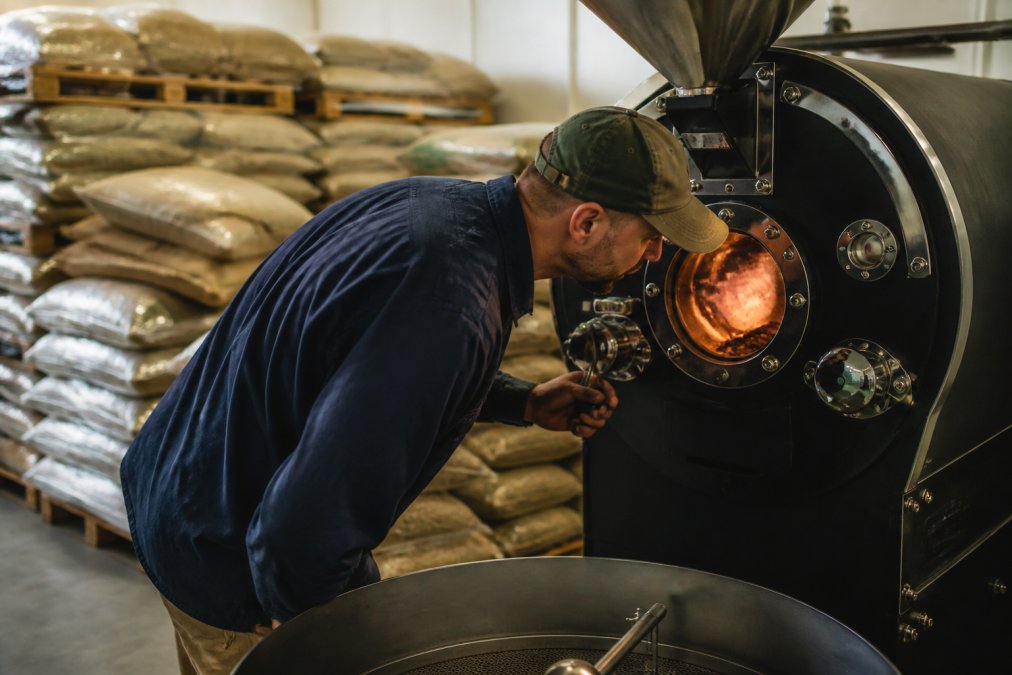
Here's what that control buys you:
- Freshness: roasted-to-order coffee ships within days of roasting, not months
- Flavor clarity: origin character survives when the roast is tuned to the bean
- Consistency within a lot: small batches are easier to taste and correct
- Traceability: you can usually find out exactly which farm the beans came from
The tradeoff is real: small batch roasting costs more per pound because the roaster can't spread fixed costs across volume. That's the honest reason a small-batch bag costs more than a supermarket tub, and it shows up in the cup.
How to Store Fresh Roasted Coffee So You Get Every Penny's Worth
Fresh roasted coffee starts losing its best flavors within days of roasting, mostly through oxidation and exposure to light, heat, moisture, and air. Storing it well is the cheapest way to protect the premium you paid for.
Follow these steps:
- Keep it whole. Grind right before brewing; ground coffee stales far faster than whole bean.
- Use an airtight container. A one-way valve bag or a sealed canister works; a rolled-down bag does not.
- Store it cool, dark, and dry. A cabinet away from the stove beats a countertop next to the kettle.
- Skip the freezer for daily use. Freezing is fine for long-term storage of unopened bags, but repeated thawing introduces moisture.
- Buy in amounts you'll finish. A half-pound every week or two beats a two-pound bag that goes flat.
- Whole bean, not pre-ground
- Airtight, opaque container
- Cool, dark cabinet
- Bag size matched to your weekly use
- Roast date noted on the bag
Climate Adaptation, Futures Markets, and What's Next for Coffee Prices
Two forces will shape premium coffee prices over the next several years, and neither is going away: the long-term capital cost of climate adaptation at origin, and the financial mechanics of the futures market.
Climate adaptation is a capital expense, not a weather event
A drought or frost is a one-season shock. Climate adaptation is a multi-year capital investment farms must make whether or not the next harvest is good, structural costs priced into green coffee before a roaster ever sees a sample.
What adaptation actually looks like on a farm:
- Shade management: planting and maintaining shade trees to buffer temperature swings and slow cherry ripening, which can protect cup quality but reduces yield per acre in the short term
- Variety replanting: replacing susceptible cultivars with more heat- and disease-tolerant varieties. Coffee trees take roughly three to four years to reach commercial production, so a replant is a multi-year bet with no revenue in between
- Irrigation and water systems: drip lines, catchment tanks, and pumps in regions that historically relied on rainfall alone
- Soil and slope management: terracing, cover crops, and erosion control on hillsides that receive more intense rainfall
- Processing infrastructure: improved washing stations and drying beds to protect quality when harvest timing shifts
None of these are optional for a farm that wants to stay in specialty production. Cooperatives and larger estates can often finance them, while smallholders cannot without premium pricing or credit, one reason the supply of genuinely high-scoring coffee tightens even when total global production looks adequate. The adaptation bill shows up in the origin premium a roaster pays, and eventually in the bag price.
How the C-price actually works, and why it matters to your bag
The C-price is the benchmark futures price for arabica coffee on the Intercontinental Exchange (ICE). It is not the price a farmer receives, and it is not the price a roaster pays. It is a reference point that the rest of the chain negotiates around. Intercontinental Exchange coffee futures overview
Three things drive the C-price day to day:
- Physical supply expectations, forecasts for the Brazilian harvest, Vietnamese robusta output, and stocks in certified warehouses
- Currency moves, coffee is priced in U.S. dollars, so a stronger dollar makes coffee more expensive for buyers in other currencies and can dampen demand
- Speculative positioning, funds and other non-commercial traders take positions based on macro trends, not on whether anyone will drink the coffee
That third driver is the one consumers rarely hear about. Speculation can push the C-price up or down sharply even when the physical harvest is fine. When it spikes, importers and roasters who buy on spot terms pay more immediately. Roasters who hedge with futures contracts lock in a price ahead of time and smooth the swing.
A futures contract is an agreement to buy or sell coffee at a set price on a future date. Roasters and importers use them to hedge; speculators use them to bet on direction. For a premium roaster, the C-price sets a floor and the specialty premium is negotiated on top of it. When the floor rises, the whole stack rises, even for beans that never trade at the commodity level.
What this means for the next few years
The direction of travel is clear: adaptation costs are rising at origin, arable high-altitude land is under pressure, and the C-price will keep swinging on weather, currency, and speculation. Roasters who buy direct, contract ahead, and pay above commodity for quality will have more stability than those buying spot. For buyers, the premium is not a markup on a commodity, it is the cost of a supply chain actively investing to keep producing coffee worth drinking.
Conclusion
The next time a bag of coffee costs more than you expected, the reason is usually a stack of real costs, not a markup. Green coffee prices, harvest volatility, fertilizer and shipping, labor at origin, small-batch roasting, origin premiums, and steady demand all add up before the beans reach your grinder. Crystal Coast Coffee Co. roasts to order from carefully sourced beans, so what you pay reflects freshness and flavor rather than shelf life and warehouse inventory. Explore the collection, including the Whiskey Barrel Aged single origin and the Coffee with Mushrooms Dark Roast, and taste the difference roasting to order makes. Get started with Crystal Coast Coffee Co. and brew a cup that earns its price.

Frequently Asked Questions
Why has coffee gotten so expensive lately?
Several forces stacked up at once. Green coffee prices on the commodity market climbed due to drought and frost in major growing regions, fertilizer and fuel costs rose, and shipping rates spiked. Labor shortages at origin pushed wages up too. When you buy premium coffee, you are also paying for roasting costs and freshness that mass-market brands cut corners on. Each layer adds to the final price per cup.
How does small-batch roasting affect the final cost of coffee?
Small-batch roasting means smaller volumes per run, closer monitoring, and more hands-on attention. That raises the per-pound roasting cost compared to industrial-scale operations that roast thousands of pounds at a time. The trade-off is freshness and flavor control. Coffee roasted to order and shipped within days of roasting tastes noticeably different from beans that sat in a warehouse for months. You pay more, but you get a product that has not lost its character.
What is the difference between commodity coffee and specialty-grade beans?
Commodity coffee is traded as a global commodity with less attention to origin, variety, or cup quality. Specialty-grade beans score 80 or above on the Specialty Coffee Association scale, meaning they have distinct flavor profiles, fewer defects, and traceable origins. Specialty coffee also often involves direct trade or fair trade relationships that pay farmers above commodity rates. That traceability and quality control add to the cost but also to what you taste in the cup.
How do ethical sourcing practices impact coffee pricing?
Fair trade and direct trade programs guarantee farmers a minimum price that covers production costs, which is often higher than the volatile commodity market rate. Origin premiums add another layer. These practices protect farmers from market fluctuations, but they also mean roasters pay more for green coffee. That cost carries through to wholesale pricing and retail markup. When you buy premium coffee, part of what you pay supports sustainable farming and better livelihoods at origin.