

Benefits of Small Batch Roasted Coffee Explained
Table of Contents
- What Small Batch Roasted Coffee Actually Means
- The Science Behind the Flavor: Maillard Reaction and Roast Profiles
- Small Batch Roasted Coffee vs. Commercial Roasting: A Direct Comparison
- Why Roast Coffee to Order Instead of Sitting on Inventory
- How to Tell If Coffee Is Fresh Before You Brew
- How to Store Roasted Coffee Beans to Protect Freshness
- How Small Batch Roasting Supports Local Supply Chains
- Frequently Asked Questions
Last Updated: August 31, 2026
What Small Batch Roasted Coffee Actually Means
Small batch roasted coffee is coffee roasted in quantities typically ranging from two to fifteen pounds per cycle, giving the roaster precise control over heat application, airflow management, and timing that simply isn't achievable at industrial scale. At Crystal Coast Coffee Co., we roast to order, which means your beans are roasted after you place your order, not weeks before.
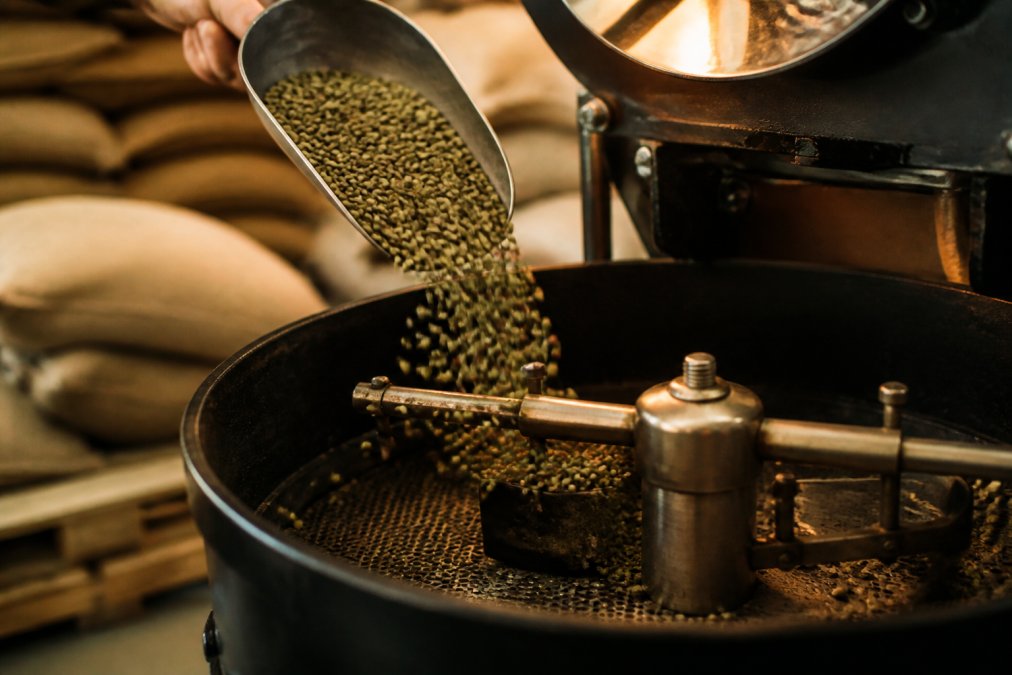
Small-scale production allows the roastmaster to monitor each batch individually, adjusting drum speed, inlet temperature, and airflow in real time. At a commercial facility running hundreds of pounds per hour, that kind of hands-on attention is impossible. Most small-batch roasters work directly with specific farms or cooperatives through direct trade relationships, meaning they can trace every bag back to a named grower, a specific region, and an altitude range. This traceability enables quality control: when a roaster knows the bean density, moisture content, and processing method of every lot, they can dial in a roast profile that brings out what's actually in the bean.
The Science Behind the Flavor: Maillard Reaction and Roast Profiles
The flavor complexity in a well-roasted coffee comes from chemistry. The Maillard reaction, the same browning process that creates crust on bread and sear on a steak, is responsible for hundreds of aromatic compounds that define a coffee's flavor notes. According to the Specialty Coffee Association's roasting resources, the Maillard reaction in coffee begins around 300°F and accelerates through the first crack stage, generating compounds that produce caramel, chocolate, and nutty notes depending on timing and temperature.
The critical difference in small-batch roasting is thermal mass. A large commercial drum loaded with hundreds of pounds of beans responds slowly to adjustments. A small drum loaded with five pounds responds almost immediately, letting the roastmaster shape the roast curve with precision, slowing development time to build sweetness or accelerating through a phase to preserve bright acidity. The roast profile, the specific temperature-over-time curve applied to a batch, is essentially a recipe for flavor. Two batches of the same origin coffee roasted to the same final temperature but with different development times will taste noticeably different.
Drum vs. Air Roasters: Equipment That Changes the Cup
The two dominant roaster types in small-scale production are drum roasters and air roasters, and they produce meaningfully different results.
Drum roasters tumble beans inside a rotating cylinder heated by conduction and convection. They're forgiving, produce consistent body, and handle many batch sizes. Most craft roasteries use drum roasters because they develop the sugars and oils that create rich, full-bodied cups.
Air roasters (also called fluid-bed roasters) suspend beans on a column of hot air. Heat transfer is almost entirely convective, which means faster roasting and cleaner, brighter cups with more pronounced acidity. Air roasters excel at highlighting delicate floral and fruit notes in high-altitude origins.
Neither is objectively superior. The choice depends on the beans and the intended flavor profile. What matters is that both types, at small-batch scale, give the roastmaster the control to make that choice intentionally.
Small Batch Roasted Coffee vs. Commercial Roasting: A Direct Comparison
Commercial roasting optimizes for consistency at scale, while small-batch roasting optimizes for quality at the individual lot level. Those are genuinely different goals, and they produce genuinely different coffee.
| Factor | Small Batch Roasting | Commercial/Industrial Roasting |
|---|---|---|
| Batch size | 2-15 lbs per cycle | 100-1,000+ lbs per cycle |
| Roast control | Manual, profile-driven | Automated, high-volume |
| Bean sourcing | Direct trade, single origin | Commodity blends |
| Freshness window | Roasted to order | Weeks to months on shelf |
| Flavor development | Tailored per origin | Standardized for consistency |
| Degassing time | Built into order process | Often bypassed |
| Shelf stability | Shorter (fresher product) | Extended (preservatives/packaging) |
| Supply chain transparency | High | Low |
Commercial roasters solve a different problem. When you need to fill grocery store shelves across forty states with a product that tastes the same in January and July, you engineer for shelf stability, not peak flavor. The trade-off is that coffee designed for shelf stability is not designed for freshness. Small-batch roasted coffee accepts a shorter freshness window in exchange for a much higher ceiling on flavor quality.
Why Roast Coffee to Order Instead of Sitting on Inventory
Roasting to order means the beans in your bag were roasted after you placed your order, not before. Most grocery store coffee was roasted weeks or months before you pulled it off the shelf.
Freshly roasted beans go through a degassing phase where they release carbon dioxide absorbed during roasting. This CO₂ protects the beans from oxidation during the first few days after roasting. After about a week, degassing slows and the beans enter their peak flavor window, typically days 7 through 21 post-roast for most origins and roast levels. After that, flavor compounds begin to degrade noticeably.
Roasting to order ensures your coffee reaches you inside that window. There's also a practical benefit for the roaster: no inventory waste. Small-batch production aligned with actual orders means no bags sitting in storage losing freshness.
How to Tell If Coffee Is Fresh Before You Brew
Fresh coffee has reliable sensory markers that anyone can learn to recognize without special equipment.
The bloom test is the most reliable indicator. When you pour hot water over fresh ground coffee, the coffee will bloom: a dome of CO₂-driven foam rises from the grounds within the first thirty seconds. A strong, vigorous bloom means the beans are fresh and still degassing. A flat, weak, or absent bloom is a clear sign the beans are stale.
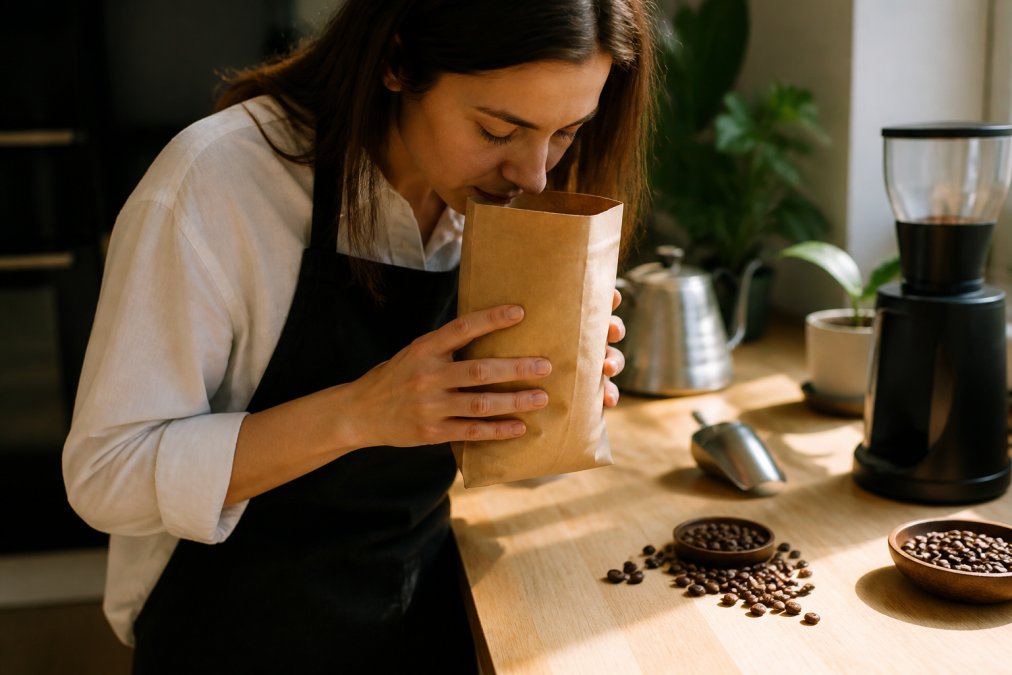
Smell the bag. Fresh roasted coffee has a vivid, complex aroma. Stale coffee smells flat, papery, or faintly like cardboard. If you open a bag and the aroma doesn't hit you immediately, the coffee is past its peak.
Check the roast date, not the best-by date. A roast date tells you when the coffee was actually made. For specialty coffee, you want to brew within 14 to 30 days of the roast date for most origins (sca.coffee). Darker roasts tend to peak earlier; lighter roasts often have a slightly longer window.
Look at the beans. Fresh beans have a matte or slightly oily surface depending on roast level. Beans that look excessively greasy or have visible white chalky patches are oxidizing. Beans that look completely dull and dry are likely old.
How to Store Roasted Coffee Beans to Protect Freshness
Knowing how to store roasted coffee beans correctly is the difference between a bag that tastes great on day 25 and one that's already flat by day 10. The enemies are simple: oxygen, moisture, heat, and light.
The right container matters. An airtight container with a one-way valve, the kind that lets CO₂ escape without letting oxygen in, is the gold standard. If you transfer to a different container, use one that seals completely.
Keep beans at room temperature. The refrigerator seems logical, but temperature cycling and ambient moisture are actively bad for coffee. Condensation forms on beans when you take them in and out, accelerating oxidation (peer-reviewed research). Room temperature, away from direct sunlight and heat sources, is the right environment.
Freeze only if you're storing long-term. Freezing is genuinely effective for extending shelf life, but only if you freeze the beans in a sealed, airtight container and don't open it until you're ready to use them. Freeze in single-serving portions so you're never thawing and refreezing.
Grind immediately before brewing. Ground coffee has dramatically more surface area than whole beans, which means it oxidizes much faster.
How Small Batch Roasting Supports Local Supply Chains
Small-batch roasted coffee moves money differently through the economy. Commercial coffee supply chains are long and anonymous. Beans pass through multiple intermediaries before reaching a roaster, and the farmer who grew the coffee often receives a commodity price set by futures markets.
Small-batch roasters who work through direct trade relationships operate on a fundamentally different model. They buy directly from farms or cooperatives, often paying above-market prices for quality lots. That premium flows back to the grower rather than disappearing into a distribution chain. The roaster gains supply chain transparency and consistent access to specific lots; the farmer gains a reliable buyer who values quality over volume.
At the regional level, small-batch roasters tend to employ locally, buy equipment from local suppliers, and source packaging domestically. The craft coffee movement has also created demand for education, sensory analysis, and origin storytelling that supports a broader ecosystem of coffee professionals.
Crystal Coast Coffee Co. sources beans from smallholder farmers worldwide, including Kintamani in Bali, the Antioquia region of Colombia, and farms in Brazil's Paraná and São Paulo states. Every origin on the menu represents a specific grower relationship, not a commodity purchase. The Bali Blue is a good starting point: hand-picked by smallholder farmers, wet-hulled, and dried on raised beds at 1,200-1,600 meters elevation.

How to Identify Small Batch Coffee on a Label
Most coffee packaging makes claims that are difficult to verify. Here's what to look for when evaluating whether a bag is genuinely small-batch:
- Roast date, not best-by date. A specific roast date is the clearest signal that a roaster tracks individual batches.
- Named origin. "Colombia" is better than "South American blend." A named farm or cooperative is better still.
- Process information. "Washed," "natural," or "wet-hulled" on a label means the roaster knows how the beans were processed.
- Altitude and variety. Specific altitude ranges and cultivar names indicate detailed knowledge of the lot.
- Batch or lot numbers. Some small-batch roasters include lot codes that trace back to a specific harvest.
Vague terms like "artisan," "craft," or "premium" carry no regulated definition and can appear on any bag. Concrete specifics are what matter.
Fresh coffee is one of the simplest pleasures to get right, and one of the easiest to get wrong by defaulting to convenience over quality. Crystal Coast Coffee Co. roasts every order to order, ships with a specific roast date on the bag, and sources directly from named farms, so you know exactly what you're getting and when it was made. Browse single-origin options like the Colombia or the Brazil Santos, or try the Whiskey Barrel Aged for something genuinely different. Get started with Crystal Coast Coffee Co. and taste what roasted-to-order actually means.


Frequently Asked Questions
Is small batch coffee actually better than mass-produced coffee?
Small batch roasted coffee consistently delivers more distinct flavor notes because roasters can monitor heat application, airflow management, and bean development in real time. Commercial roasting prioritizes throughput over precision, which flattens flavor profiles. With small batches, the roastmaster can adjust the roast curve for each origin, preserving the bean's natural characteristics. The result is a cup with cleaner, more complex flavors rather than the flat, generic taste common in grocery store bags.
How long should you wait to drink coffee after it has been roasted?
Freshly roasted coffee needs 24 to 72 hours to degas before brewing. During roasting, beans release CO2, and if brewed too soon, that gas interferes with extraction and produces a sour, uneven cup. Most specialty coffee roasters recommend a 2 to 5 day rest for filter brewing and up to 10 days for espresso. After that degassing window, the freshness window for peak flavor typically runs 2 to 4 weeks from the roast date when stored properly.
What defines a 'small batch' in the coffee industry?
There is no official regulatory definition for small batch coffee in the United States. In practice, most craft roasters use the term to describe roasting runs under 25 pounds per batch, though some specialty operations roast as little as 5 to 10 pounds at a time. The key distinction is not just the batch size but the intent: small batch roasting prioritizes hands-on quality control, sensory analysis through cupping, and roasting to order rather than building warehouse inventory.
Does the roasting method affect the health benefits of coffee?
Roast level does influence antioxidant content. Lighter roasts generally retain more chlorogenic acids, which are the primary antioxidants in coffee. Darker roasts reduce these compounds through prolonged heat application but develop other beneficial compounds in the process. Small batch roasting allows precise control over roast level, so you can choose a profile that matches both your flavor preference and your health priorities. The freshness of small batch coffee also means fewer oxidation-related losses before the beans reach your cup.
This article was written using GrandRanker