

Premium Coffee Beans for Daily Brewing: 2026 Guide
Table of Contents
- Why Freshness and Roast-to-Order Matter for Daily Brewing
- Quick Comparison: Premium Coffee Beans for Daily Brewing
- Single Origin vs. Blends: Which Premium Coffee Beans Fit Your Routine?
- How to Brew Better Coffee at Home with Premium Beans
- How to Grind Coffee Beans for Different Brewing Methods
- Best Coffee Bean Storage Tips for Daily Freshness
- Budget-to-Quality Ratio: What $22.99 per Bag Actually Gets You
- Subscription Fatigue and Flexibility: Ordering Premium Beans on Your Terms
- Frequently Asked Questions
Last Updated: September 15, 2026
Why Freshness and Roast-to-Order Matter for Daily Brewing
Premium coffee beans for daily brewing are specialty-grade beans roasted in small batches and shipped close to their roast date, so your morning cup tastes the way the roaster intended. This guide from Crystal Coast Coffee Co. covers how to choose, grind, store, and brew them without wasting money or flavor.
Coffee begins losing aromatic compounds the moment it leaves the roaster, and whole bean coffee holds peak flavor for roughly two to four weeks (Changes in sensory quality characteristics of coffee during storage). A "best by" date a year out tells you nothing about roast date.
Grocery shelves optimize for shelf life; a daily brewer needs the opposite. Roast-to-order flips the model, beans are roasted after you order, rest briefly, then ship.
Quick Comparison: Premium Coffee Beans for Daily Brewing
Every bag in the Crystal Coast lineup is $22.99 and roasted to order. The difference is flavor profile and the brewing method each suits.
| Coffee | Type | Tasting Notes | Best For |
|---|---|---|---|
| House Blend | Medium roast blend | Nutty, sweet chocolate, mild citrus | Drip and pour over |
| Breakfast Blend | Medium roast blend | Smooth, balanced, approachable | First cup of the day |
| Latin American Blend | Medium-dark blend | Nutty, mild fruit, cocoa aftertaste | Drip and French press |
| Brazil Santos | Single origin | Cocoa, elegant, smooth | Espresso and milk drinks |
| Colombia | Single origin | Dried orange, berry, chocolate | Pour over and drip |
| Guatemala | Single origin | Dark chocolate, bright fruit, butterscotch | Pour over |
| Peru | Single origin | Salted caramel, silky sweet, citrus | Drip and cold brew |
| Sumatra | Single origin | Dark chocolate, dried fruit, earthy | French press and espresso |
| 6 Bean Blend | Dark roast blend | Bold, espresso-forward | Espresso |
| 12 Pack Capsules | Single-serve blend | Rich, consistent | Pod machines |
If you want one bag that works across every method, House Blend is the safest starting point. If you know your equipment, jump to the matching section.

Single Origin vs. Blends: Which Premium Coffee Beans Fit Your Routine?
Blends win for consistency, single origins win for curiosity. A blend is engineered to taste the same every reorder, which matters when coffee is a daily habit. A single origin reflects one farm, one region, one harvest, so flavor shifts batch to batch.
Blends earn their place in a daily routine because they remove variables, exactly what you want at 6:30 a.m.
Single origins reward attention. Colombia brings dried orange and berry notes with a chocolate finish, Guatemala leans into dark chocolate and butterscotch, and Sumatra is the outlier: syrupy body, earthy depth, and a lingering finish.

Processing shapes flavor as much as origin. Washed coffees like Colombia and Guatemala taste cleaner and brighter; natural and pulped natural coffees like Brazil Santos read sweeter and heavier.
How to Brew Better Coffee at Home with Premium Beans
Better home brewing comes down to four variables: grind consistency, brew ratio, water temperature, and time. Get those roughly right and even a modest setup outperforms most coffee shops.
Start with a scale. Weighing beans instead of scooping removes the biggest source of inconsistency. Start at 1 gram of coffee to 15-16 grams of water, then adjust toward 1:14 for stronger or 1:17 for lighter.
Water temperature matters more than most people expect. Aim for 195-205°F (Brew temperature, at fixed brew strength and extraction, has little impact on the sensory...). Boiling water scorches delicate floral and citrus notes; water below 195°F under-extracts and tastes sour and thin.
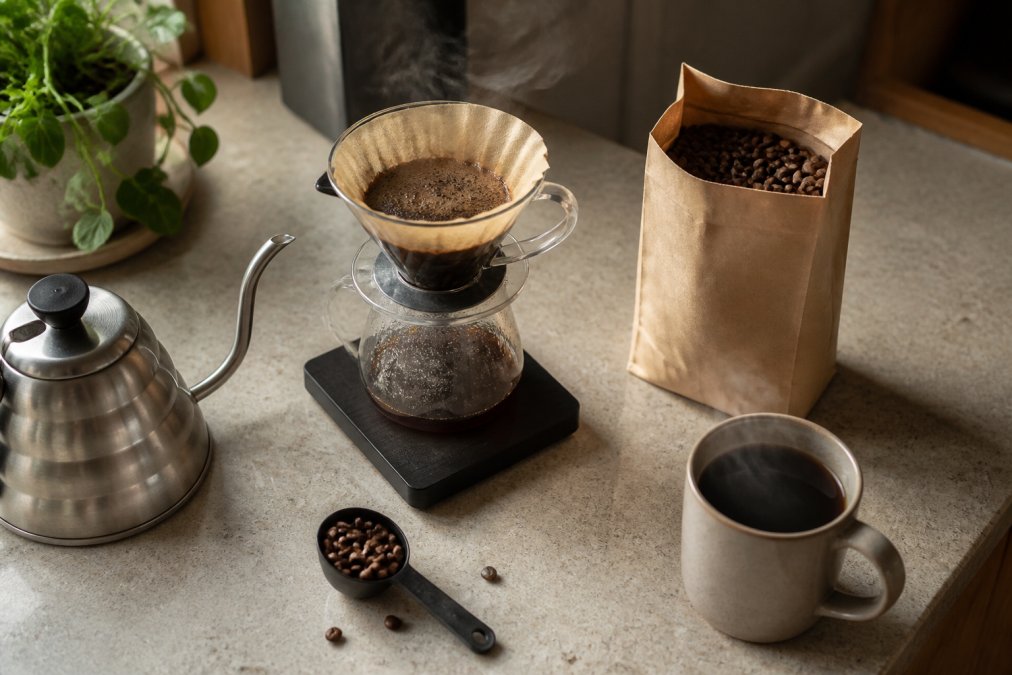
Then there is the bloom. Pour roughly twice the coffee's weight in water, wait 30-45 seconds while the bed expands and releases carbon dioxide, then continue pouring (Effect of Temperature and Storage on Coffee’s Volatile Compound Profile and Sensory...). Skipping it shows up as a flat, muted cup.
Equipment-Specific Pairing for Daily Brewing
Match the bean to the machine you already own rather than buying new gear.
- Drip machine: House Blend or Breakfast Blend. Medium roasts tolerate the wider temperature swings of a standard drip brewer.
- Pour over: Colombia or Guatemala. Bright, complex single origins reward the control a pour over gives you.
- French press: Sumatra or Latin American Blend. Full immersion favors heavier body and lower acidity.
- Espresso: 6 Bean Blend or Brazil Santos. Dark roasts and cocoa-forward beans cut through milk.
- Cold brew: Peru. Its caramel sweetness holds up over a long steep.
- Pod machine: 12 Pack Single Serve Capsules, sealed with no oxygen inside so the grounds stay fresh.
How to Grind Coffee Beans for Different Brewing Methods
Grind size is the fastest way to ruin good beans, and the variable most daily brewers get wrong because they treat it as a fixed setting instead of a dial. The rule: the longer water contacts the coffee, the coarser the grind.

Here is the working range most specialty roasters reference, in the descriptors you will see on a grinder dial:
- Espresso: fine, like powdered sugar, roughly 200-300 microns
- Moka pot: fine-medium, like fine sand
- Pour over (V60, Chemex): medium-fine, like table salt, roughly 500-700 microns
- Drip machine: medium, like coarse sand, roughly 700-900 microns
- French press: coarse, like sea salt, roughly 900-1,100 microns
- Cold brew: extra coarse, like peppercorns, 1,100 microns and up
Those numbers are starting points, not laws. Bean density, roast level, and processing shift how fast water moves through the bed, a dark roast is more porous and extracts faster, so it often wants a coarser grind than a light roast.
Dialing In by Taste, Not by Chart
Charts get you into the neighborhood; taste gets you to the address. A sour, thin, or salty cup is under-extracted, go finer, one click at a time. A bitter, dry, or hollow cup is over-extracted, go coarser. Change one variable per brew.
Many daily brewers lock a grind setting and stop adjusting. That works only if the bean stays the same. Every time you switch from a medium-roast blend to a dark-roast single origin, expect to move the dial two to four clicks.
Why Burr Beats Blade for Daily Brewing
A burr grinder crushes beans between two hardened surfaces set to a fixed gap, so particles come out close to the same size.
Grind Freshness and the Daily Workflow
Best Coffee Bean Storage Tips for Daily Freshness
What Is Actually Happening Inside the Bag
Container Options, Ranked for Daily Use
The Freezer Question
Buy in the Window You Can Actually Drink
Budget-to-Quality Ratio: What $22.99 per Bag Actually Gets You
Subscription Fatigue and Flexibility: Ordering Premium Beans on Your Terms
Frequently Asked Questions
What are the best premium coffee beans for everyday use?
The best beans for daily brewing balance flavor, freshness, and cost. Medium roasts like Crystal Coast Coffee Co.'s House Blend ($22.99) work well for most brewing methods, offering nutty and sweet chocolate notes. Single origins like Colombia or Guatemala suit drinkers who want distinct tasting notes. Look for a roast-to-order model and a visible freshness date, since beans lose flavor within weeks of roasting.
Are single-origin beans better for daily brewing than blends?
Neither is universally better. Single origins highlight specific flavors tied to one region, like the dried orange and berry notes in Crystal Coast's Colombia. Blends combine beans for consistency and balance, which suits daily routines where you want the same cup every morning. Try a blend for your everyday brew and a single origin for weekend experimentation.
How should I store premium coffee beans to keep them fresh?
Keep beans in an airtight, opaque container at room temperature, away from light, heat, and moisture. Do not refrigerate or freeze daily-use beans, as condensation harms flavor. Buy amounts you will finish within two to three weeks of the roast date. If you buy in bulk, freeze portions in sealed bags and thaw fully before grinding.
Does roast level affect the quality of daily coffee?
Roast level changes flavor more than quality. Medium roasts keep more origin character, with brighter acidity and clearer tasting notes. Dark roasts taste bolder and smokier because roasting develops sugars and oils further. For daily brewing, medium roasts offer flexibility across drip, pour-over, and espresso, while dark roasts suit milk drinks and cold brew.
How do I grind coffee beans for different brewing methods?
Grind size should match your brew method and contact time. Use coarse grinds for cold brew and French press, medium for drip and pour-over, and fine for espresso and moka pot. A burr grinder gives more consistent particles than a blade grinder. Grind right before brewing, since ground coffee loses aroma within minutes.