

French Press vs Pour Over for Bold Coffee Flavor
Table of Contents
- French Press vs Pour Over for Bold Coffee Flavor: The Short Answer
- What Bold Coffee Flavor Actually Means (Versus Strong Coffee)
- French Press Coffee Ratio: Dialing In Body and Richness
- Pour-Over Coffee Grind Size: Clarity, Acidity, and Control
- The Best Coffee Brewing Method for Dark Roast
- How to Make Bold Coffee: Recipe Adjustments for Each Method
- Side-by-Side Tasting: A Controlled Way to Choose
- Conclusion
- Frequently Asked Questions
Last Updated: October 6, 2026
French Press vs Pour Over for Bold Coffee Flavor: The Short Answer
If you want bold coffee flavor with weight and richness, the French press wins. If you want clarity and brightness with a lighter body, pour-over wins.
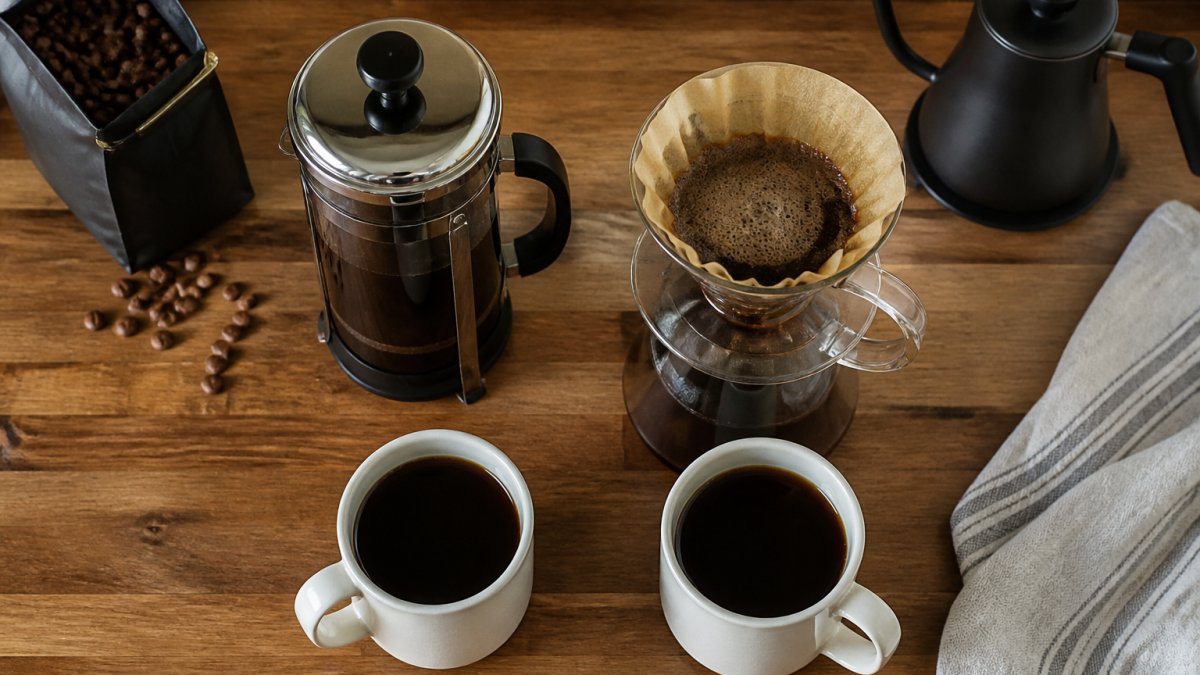
The short version: a French press keeps the coffee oils and fine particles in the cup, which is where that heavy, coating mouthfeel comes from. A pour-over traps most of those in a paper filter, leaving a cleaner, more transparent brew. Neither is better.
Quick Comparison: French Press vs Pour Over
| Factor | French Press | Pour Over |
|---|---|---|
| Body and texture | Full-bodied, heavy | Light to medium |
| Flavor clarity | Lower, muddier | High, nuanced |
| Coffee oils | Retained | Mostly filtered out |
| Sediment | Some in the cup | Almost none |
| Control | Forgiving | Demands precision |
| Best for | Bold, rich cups | Bright, clean cups |
What Bold Coffee Flavor Actually Means (Versus Strong Coffee)
Bold coffee flavor is a description of taste and mouthfeel, not caffeine or concentration. Bold describes heavy body, low perceived acidity, deep roasted notes, and a long finish. Strong coffee simply means a higher coffee-to-water ratio, which raises concentration without changing character.
This distinction matters more than most guides admit. You can brew a very strong cup that tastes thin and sharp. You can also brew a moderate-strength cup that feels thick and rich. Boldness comes from oils, roast level, and extraction, not from piling in more grounds.
French Press Coffee Ratio: Dialing In Body and Richness
A reliable starting point for French press coffee ratio is 1:15 by weight, meaning one gram of coffee to fifteen grams of water. For a bolder, heavier cup, tighten that toward 1:12.
Use a coarse grind, roughly the texture of sea salt. Water should sit just off a boil, around 200°F. Add the grounds, pour in about twice their weight in water, and let the bed bloom for 30 seconds.
Push the plunger down at a steady pace. Slamming it down stirs up sediment and makes the cup muddy.
Immersion Brewing and Coffee Oils
Immersion brewing means the grounds sit fully submerged in water for the entire steep. Nothing escapes. The coffee oils, including compounds like cafestol and kahweol, stay in the liquid, and so do the finest particles that slip past the mesh.
That is the whole reason a French press tastes richer. Those oily compounds coat the tongue and carry roasted, chocolatey, sometimes earthy notes forward. A paper filter catches most of them. A metal mesh filter catches far less, which is why the press keeps its signature weight.
Pour-Over Coffee Grind Size: Clarity, Acidity, and Control
Pour-over coffee grind size should land between medium and medium-fine, closer to table salt than sea salt. That range lets water pass through the bed at a steady rate without stalling or racing.
Everything about pour-over is about control. You control the pour, the bloom, the water temperature, and the drawdown time.
Get it wrong and you get a hollow, sour, or bitter cup. There is very little margin for error.
Paper Filter vs Metal Mesh Filter
The filter decides the cup more than almost any other variable. A paper filter absorbs oils and traps fines, producing a clean, bright, tea-like body. A metal mesh filter lets oils and some sediment through, giving you a cup that sits between pour-over and French press.
If boldness is your goal, a metal mesh filter in a pour-over setup gets you closer. If clarity is the goal, paper wins every time.
The Best Coffee Brewing Method for Dark Roast
The best coffee brewing method for dark roast is the French press. Dark roasted beans are already low in acidity and high in developed, bittersweet notes, and the press amplifies exactly those qualities. It also hides the harshness that dark roasts can show when brewed too aggressively.
Pour-over still works with dark roast, but it strips away the oils that make those beans taste rich. You end up with a cleaner cup that reads thinner and more one-dimensional.
How Roast Level and Bean Origin Shift the Comparison
Roast level changes the answer more than brewing method does. A light roast in a French press still tastes relatively bright, because the bean itself has more acidity to give. A dark roast in a pour-over still tastes roasty, because that flavor was locked in at the roaster.
Bean origin matters too. Indonesian beans, like our Sumatra, carry syrupy body and earthy, dark chocolate notes that lean naturally bold. A medium-dark Honduran lot brings caramel and brown sugar instead. Match the bean to the method rather than fighting it.

How to Make Bold Coffee: Recipe Adjustments for Each Method
Learning how to make bold coffee comes down to four levers: ratio, grind, temperature, and time. Tighten the ratio, keep the grind consistent, hold the temperature steady, and extend contact time slightly.
For the French press:
- Drop the ratio to 1:12 for a heavier cup
- Keep the grind coarse and even
- Steep four to five minutes
- Press slowly and decant immediately
For pour-over:
- Use 1:14 instead of 1:16
- Shift the grind one step finer
- Pour in slow, controlled circles
- Aim for a total brew time near three minutes
Our French Roast is built for this. It is a deep dark roast with an oil sheen and low acidity, so it holds up to a tight ratio without turning sharp.

Troubleshooting Weak, Bitter, or Muddy Cups
Weak coffee usually means the grind is too coarse or the ratio too loose. Tighten one variable at a time.
Bitter coffee almost always means over-extraction: water too hot, steep too long, or grind too fine. Back off the time first.
Muddy French press coffee comes from a grind that is too fine or a plunger pushed too fast. Coarsen the grind and slow down. If sediment still bothers you, let the press sit an extra minute after pressing before you pour.
Side-by-Side Tasting: A Controlled Way to Choose
Most comparisons tell you which method is bolder. Almost none tell you how to find out for yourself. This is a repeatable protocol you can run in about 30 minutes with equipment you already own.
Step 1: Control the Variables
The whole point is to isolate brewing method as the only difference. That means holding everything else constant:
- Same bean, same roast date. Use one bag, ideally within two weeks of roast. Stale beans taste flat in both methods and will muddy your results.
- Same dose. Weigh both brews. A common starting point is 20 grams of coffee. Do not eyeball it, a scoop of coarse grounds and a scoop of medium grounds weigh different amounts.
- Same water. Use the same water for both, and the same temperature. Around 200°F is a reasonable target for both methods.
- Same total water weight. If you use 300 grams of water for the press, use 300 grams for the pour-over. This keeps concentration comparable so you are judging character, not strength.
- Same grind setting relative to method. Coarse for the press, medium to medium-fine for the pour-over. Do not use the same grind for both, each method needs its own setting to extract properly.
Step 2: Brew Both, Back to Back
Brew the French press first, since it needs a four-minute steep. Start the pour-over as the press finishes steeping so both cups are ready within a minute or two of each other. Hot coffee tastes different from warm coffee, and you want a fair comparison.
Decant the press immediately after plunging so it does not keep extracting. Serve the pour-over straight from the dripper.
Step 3: Taste Blind
Pour each into an identical mug. Label them underneath with a piece of tape or a marker on the base, not on the rim where you will see it. Have someone else swap the mugs if you can, or close your eyes and shuffle them yourself.
Step 4: Score Four Criteria
Slurp from a spoon if you want to taste like a professional, it aerates the coffee and spreads it across your palate. Otherwise, take a small sip and let it sit on your tongue for a few seconds before swallowing. Score each cup on these four dimensions:
- Body and mouthfeel. Is it thin like tea, or does it coat your tongue? Rate it light, medium, or heavy.
- Acidity. Does it taste bright and juicy, or smooth and low? Brightness often shows up as a tingling sensation on the sides of your tongue.
- Flavor clarity. Can you pick out specific notes, chocolate, fruit, nuts, or does everything blur together? Clarity is where pour-over usually wins.
- Finish. How long does the flavor linger after you swallow? A bold cup often has a long, coating finish; a clean cup fades more quickly.
Step 5: Compare and Decide
Write down your scores before you reveal which cup was which. Most people find the French press scores higher on body and finish, while the pour-over scores higher on acidity and clarity. That is the expected result, but the useful information is which of those qualities you personally weight more.
A common pattern is that drinkers prefer one method in the morning and the other in the afternoon, or one for black coffee and the other when adding milk. There is no wrong answer.
Conclusion
Choosing between a French press and a pour-over is really a choice about what you want from the cup. Bold coffee flavor lives in the oils and body that a press preserves. Clarity and brightness live in the paper-filtered precision of a pour-over.
At Crystal Coast Coffee Co., we roast to order so the beans arrive fresh enough to show their character either way. Our French Roast and 6 Bean Blend both bring the deep, rich notes that a French press was made for.

Frequently Asked Questions
Does French press or pour over coffee taste better?
Neither wins outright. French press coffee tastes fuller-bodied, richer, and heavier because a metal mesh filter lets coffee oils and fine sediment through. Pour over tastes cleaner, brighter, and more nuanced because a paper filter traps most of those oils. If you want bold coffee flavor with weight and texture, the French press delivers it more directly. If you want to taste the acidity and origin character of a lighter roast, pour over shows it more clearly.
Is French press coffee stronger than pour-over coffee?
Not automatically. Strength is about concentration, which comes from your coffee-to-water ratio, grind size, and brew time, not the device itself. A French press brewed at 1:15 with a coarse grind can taste stronger than a pour over, but a pour over brewed at 1:12 will taste stronger than a weak French press. Boldness is a separate quality: French press coffee feels heavier and oilier on the palate, while pour over tastes thinner and more transparent.
Can you use dark roast coffee in a pour-over?
Yes, and it works well once you adjust the recipe. Dark roasts are more soluble, so they extract faster. Use a slightly coarser pour-over coffee grind size, keep water temperature around 195 to 200 degrees Fahrenheit, and shorten the total brew time. Crystal Coast Coffee Co.'s French Roast, with its low acidity and bittersweet profile, brews into a bold pour-over when you avoid over-extraction.
How do grind size and brew time affect French press and pour-over flavor?
In a French press, a coarse grind and a four-minute steep produce a full-bodied cup; too fine a grind turns it muddy and bitter. In a pour over, a medium grind and a two-and-a-half to three-minute brew produce clarity; too fine a grind slows the drawdown and makes the cup harsh. Grind size and brew time are the two levers that decide whether bold coffee flavor reads as rich or as burnt.
What are the downsides of using a French press?
A French press leaves sediment in the cup, which some drinkers dislike, and it retains more coffee oils. A French press also requires a coarser grind and a full four-minute steep, which takes more hands-on time than a pour over.