

Why Specialty Coffee Beans Taste Different: A 2026 Guide
Table of Contents
- Why Specialty Coffee Beans Taste Different: The Core Factors
- How Processing Methods Affect Coffee Taste
- Coffee Flavor Notes Explained: What You Are Actually Tasting
- The Benefits of Small Batch Roasted Coffee for Flavor
- Origin, Altitude, and Varietal: How Place Shapes Taste
- The Grinder and Brewing Variables: Where Flavor Is Won or Lost
- Frequently Asked Questions
Last Updated: September 16, 2026
Why Specialty Coffee Beans Taste Different: The Core Factors
Specialty coffee beans taste different because flavor is determined long before brewing, starting with genetics, soil, altitude, and processing. At Crystal Coast Coffee Co., we roast to order because those variables are fragile; they fade with time and mishandling. This guide breaks down each factor in the chain, from seed to cup.
Specialty Coffee Association's grading standards and cupping protocols
From Seed to Cup: What Changes Flavor
Every stage in the supply chain either concentrates flavor or dilutes it. Variety and growing conditions set the ceiling; processing, roasting, and brewing determine how much of it you reach.
- Genetics (varietal): Different cultivars produce different flavor compounds. A Bourbon and a Catimor grown side by side will not taste the same.
- Terroir: Soil composition, rainfall, shade, and altitude shape how the plant develops sugars and acids.
- Harvest selectivity: Only ripe cherries produce sweet, clean coffee. Underripe and overripe fruit introduce astringency and flatness.
- Processing: How the fruit is removed and dried dictates the bean's acidity, body, and fermentation character.
- Roast profile: Heat development builds aroma through the Maillard reaction and caramelization, and can just as easily flatten it.
- Freshness: Roasted coffee releases carbon dioxide for days after roasting, then begins losing volatile compounds to oxidation.
How Processing Methods Affect Coffee Taste
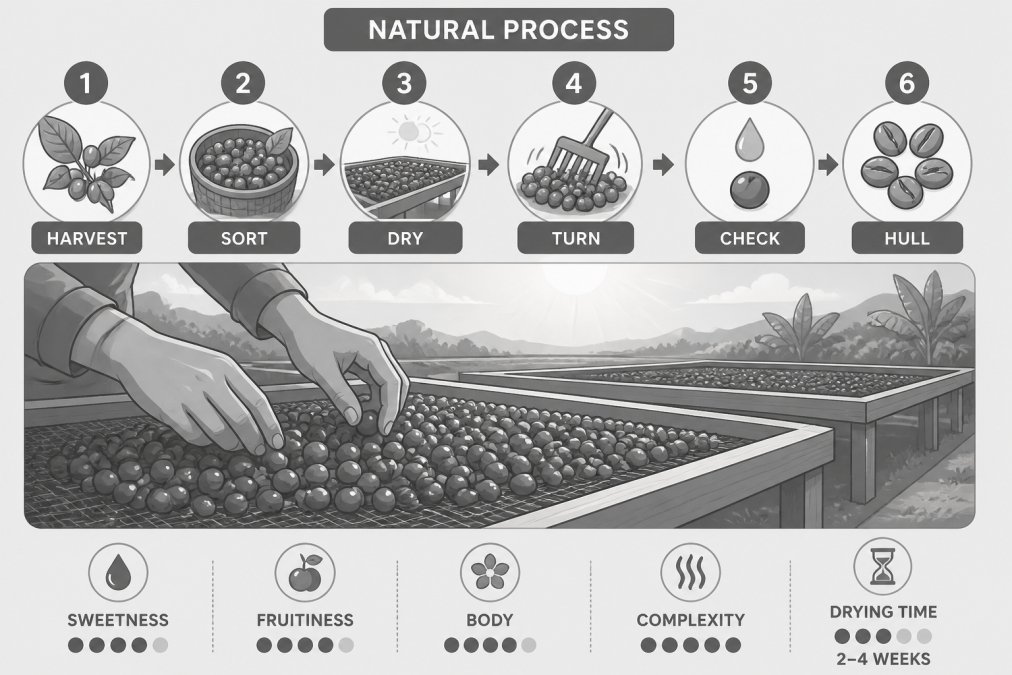
Processing methods affect coffee taste by controlling how much fruit contact the bean has before drying, which determines acidity, body, and fermentation character. Washed coffees tend to be clean and bright; naturals fruity and heavy-bodied; honey coffees sit between the two.
Washed, Natural, and Honey: A Quick Comparison
| Method | How It Works | Typical Flavor Impact | Body |
|---|---|---|---|
| Washed | Fruit removed before drying | Clean, bright, high acidity | Lighter |
| Natural | Dried whole with fruit intact | Fruity, fermented, sweet | Heavier |
| Honey | Some mucilage left on during drying | Balanced, syrupy, mild fruit | Medium |
A common mistake is assuming natural-process coffees are always sweeter. Naturals amplify whatever was already in the fruit, including defects; poorly sorted naturals taste muddy, not fruity.
Coffee Flavor Notes Explained: What You Are Actually Tasting
Coffee flavor notes are the aroma and taste compounds you perceive when you drink, mapped to reference points like fruit, chocolate, or nuts. When a bag says "milk chocolate, fruity, caramel," it describes the sensory impression of the compounds present, not added flavoring. The gap most guides leave open is the chemistry: which compounds produce those notes, and where they come from.
The Two Reactions That Build Flavor
Two chemical reactions do most of the work during roasting. The Maillard reaction begins around 300°F when amino acids and reducing sugars react, producing brown pigments (melanoidins) and aroma compounds. Caramelization kicks in slightly higher as sugars break down on their own, developing sweetness and brown-sugar depth. Push the roast further and those compounds degrade into bitter, smoky notes.
Strecker Degradation: The Missing Piece
Most articles stop at Maillard. The step that separates a fruity Ethiopian from a bready Brazilian is Strecker degradation, a side reaction of Maillard in which amino acids convert into aldehydes and other volatile compounds. This is where many of coffee's most distinctive aromas originate:
- Aldehydes, contribute fruity, floral, and sometimes grassy notes. Higher in lightly roasted, high-altitude coffees.
- Pyrazines, nutty, earthy, and roasty. Build with roast development and dominate darker profiles.
- Furans, sweet, caramel-like, and slightly burnt at higher concentrations.
- Terpenes and esters, the floral and citrus compounds that survive best in washed, lightly roasted coffees.
- Phenols, spicy and smoky; overdeveloped phenols read as ash.
Acidity, Body, and Mouthfeel
Acidity is not the same as sourness. In coffee, acidity describes the bright, lively sensation that gives a cup structure, and it marks quality when balanced. The main acids, citric, malic, and phosphoric, each read differently (citric as citrus, malic as apple or stone fruit, phosphoric as sparkling, cola-like brightness). Body and mouthfeel describe weight and texture, from tea-like to syrupy, driven largely by dissolved solids, oils, and melanoidins.
A Beginner's Tasting Exercise
You do not need a cupping spoon or score sheet to taste deliberately. Try this:
- Smell the dry grounds before brewing. Most of what you call "taste" is retronasal aroma, and the dry grounds give you the clearest read on the volatile compounds still present.
- Slurp, don't sip. Drawing coffee across your palate aerates it and pushes aroma into your nasal cavity, which is how cuppers detect specific notes.
- Name what you taste against a reference. "Fruity" is vague; "blueberry" or "dried cherry" is useful. The SCA flavor wheel exists for exactly this reason.
- Wait for the finish. Sweetness and body often show up after you swallow, not on the first sip.
- Write it down. Palate memory is short. A one-line note per coffee builds calibration fast.
The Benefits of Small Batch Roasted Coffee for Flavor
The benefits of small batch roasted coffee come down to control and timing: smaller batches let a roaster adjust the roast profile to the specific bean and ship it closer to the roast date, so more aroma compounds survive to your kitchen. Freshness is the biggest variable most drinkers can control.
Origin, Altitude, and Varietal: How Place Shapes Taste
Origin, altitude, and varietal shape taste because they determine how slowly the cherry develops and what the plant has to work with. Higher altitudes and denser beans generally produce more acidity and complexity; cultivars carry their own flavor signatures.
Why Altitude and Soil Matter
Coffee grown at higher elevations matures more slowly, allowing sugars and acids to concentrate in the bean, which is why high-altitude coffees taste brighter and more layered. Lower-altitude coffees ripen faster and often land flatter and heavier.
The Grinder and Brewing Variables: Where Flavor Is Won or Lost
The grinder and brewing variables determine how much of the flavor built on the farm and preserved at the roaster makes it into your cup. Extraction, dissolving soluble compounds from ground coffee into water, is unforgiving. Most guides list grind, ratio, and water and stop. The variable that separates a clear cup from a muddy one is particle size distribution, and almost nobody explains it.
Particle Size Distribution: Fines, Boulders, and Flavor Clarity
No grinder produces perfectly uniform particles. Every grind setting produces a distribution: a target range of ideal particles, plus fines (dust-like particles much smaller than the target) and boulders (oversized chunks). This distribution, not average grind size, determines flavor clarity.
- Fines extract fast. They give up their solubles in seconds, which is why a cup with too many fines tastes sharp, sour, and sometimes harsh even when the rest of the bed is extracting correctly.
- Boulders extract slowly. They release their solubles late, or not at all, leaving the cup thin and hollow with a drying finish.
- The target range extracts on schedule, delivering the sweetness, acidity, and body the roaster intended.
Why the Grinder Beats the Brewer
Home brewers often upgrade the brewer first. In practice, the grinder matters more. A $200 brewer fed by a blade grinder will underperform a $40 pour-over fed by a consistent burr grinder, because the brewer can only work with the particle distribution it is given. The grinder is the variable you change most often and the one that most directly controls extraction uniformity.
The Other Variables, In Order of Impact
Once grind is dialed in, the remaining variables matter in roughly this order:
- Brewing ratio: A common starting point is roughly 1 gram of coffee to 15-17 grams of water, adjusted to taste. Tighter ratios (1:15) read bolder; looser ratios (1:17) read lighter and more tea-like.
- Water quality: Water makes up the vast majority of your cup. Heavily chlorinated or extremely hard water flattens flavor no matter how good the beans are. The SCA publishes target ranges for total dissolved solids, alkalinity, and hardness; most tap water falls outside them, which is why filtered or remineralized water is a common upgrade.
- Water temperature: Most brewing falls between 195°F and 205°F. Cooler water under-extracts; boiling water can scald and push bitterness.
- Agitation and time: Stirring, pouring technique, and contact time all shift extraction, but they are fine-tuning levers once grind and ratio are set.
SCA's water quality standards for coffee brewing
Frequently Asked Questions
Why do different coffee beans taste different?
Every coffee bean carries the fingerprint of its origin, variety, and processing method. Altitude, soil, and climate shape the raw bean; then washing, natural drying, or honey processing alters how sugars and acids develop. Roast level and brewing variables finish the job. A washed Kenyan bean and a natural Ethiopian bean can taste completely different even when roasted identically, because their chemistry started in different places.
How do processing methods like natural vs. washed impact coffee flavor?
Natural processing dries the whole cherry around the bean, letting fruit sugars ferment into the seed. The result is heavier body, lower acidity, and pronounced berry or tropical fruit notes. Washed processing removes the fruit before drying, producing cleaner, brighter cups with sharper acidity and more floral or citrus character. Honey processing sits between them, leaving some mucilage on the bean for added sweetness and balance.
Does the roasting process change the flavor of coffee beans?
Roasting transforms green coffee through the Maillard reaction and caramelization, creating hundreds of aromatic compounds. Light roasts preserve origin-specific acidity and floral notes. Medium roasts balance sweetness and body. Dark roasts push caramelization further, replacing delicate notes with chocolate, molasses, and smoky tones. A small batch roaster can adjust the roast profile to highlight what makes each bean unique rather than masking it.
What factors influence the flavor profile of specialty coffee?
Four main factors: origin (terroir, altitude, varietal), processing method, roast profile, and brewing variables. Origin sets the potential; processing and roasting develop it; grinding and brewing either reveal or ruin it. Water quality, brewing ratio, and particle size all affect extraction. Even the freshest specialty coffee beans can taste flat if ground too coarse or brewed with mineral-heavy water.